



Rethinking Human-Robot Interaction
- Robotics
- Intralogistics
- 18.2.2026
- Reading Time: {{readingTime}} min
Contents
In modern logistics and production environments, collaboration between humans and mobile robots is becoming a decisive success factor. Conventional automation reaches its limits wherever processes are dynamic and human decision-making remains essential. What is needed are assistance systems that adapt to people in real time – not the other way around.
This is precisely where the European research project AI-Prism (AI Powered human-centred Robot Interactions for Smart Manufacturing) comes into play. Its objective is to enable natural, safe and barrier-free interaction between humans and robots – especially in dynamic production and logistics environments. KEBA is actively involved in the development as a technology partner.
AI Prism is an important innovation component for KEBA. By participating in the project, we can bring together research, industrial practice, and customer requirements at an early stage and further develop new approaches to human-robot interaction in a targeted manner.”
Intuitive Interaction Instead of Programming
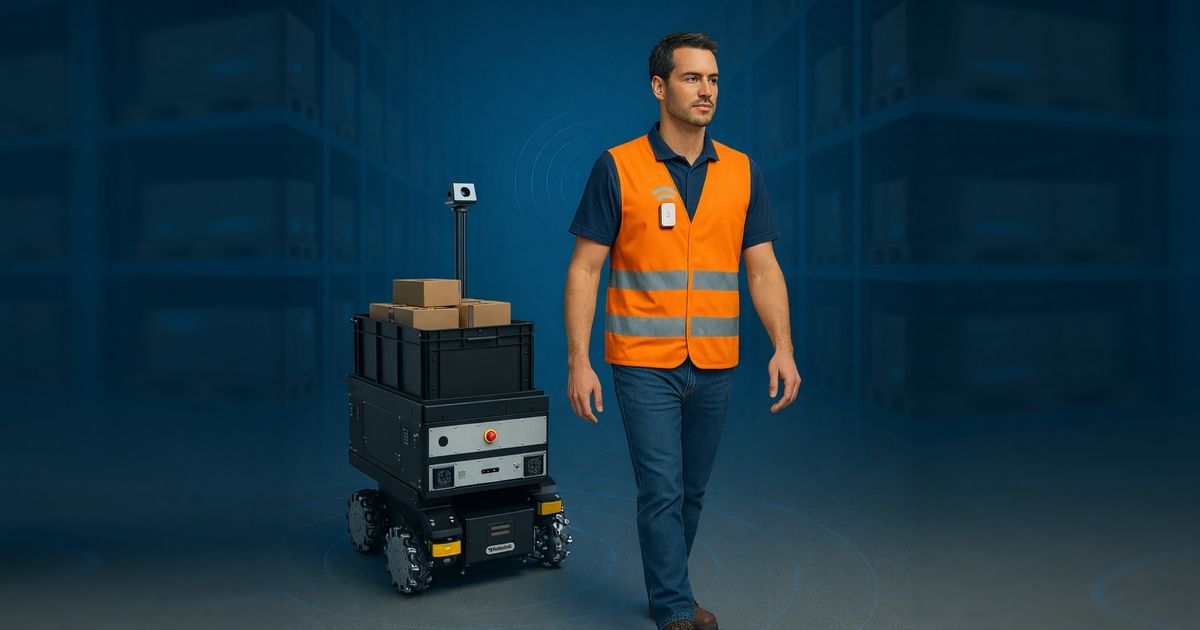
At the core of AI-Prism is a clear human-centred approach. In the future, mobile robots are expected to be operated without complex programming and to respond intuitively to speech, gestures and human movement. This will make collaboration intuitive and efficient – a crucial step toward making robots widely usable in intralogistics.
The project investigates and combines several interaction modalities:
Voice control to trigger navigation or transport tasks
Gesture recognition, interpreting hand and arm movements as control inputs
Follow-me mode, enabling robots to autonomously follow operators
Assistance functions to support physically demanding or repetitive tasks
Together, these capabilities form the basis for cooperative human-robot interaction, in which humans and robots complement each other and continuously learn from interaction.
Industrial Implementation
At KEBA, the results of AI-Prism are transferred into practice with a strong focus on industrial applicability. A central element is the Kemro X automation platform.
Kemro X acts as an intelligent control and orchestration layer, integrating AI, sensor technology and image processing. It enables real-time communication between humans and robots and ensures the reliable operation of complex systems within open system architectures.
Initial demonstrators already show how mobile robots can recognise human movements, interpret spoken commands and react contextually – a key capability for flexible and safe intralogistics applications.
Relevance for the Future of Intralogistics
Relevance for the Future of Intralogistics In future intralogistics environments, mobile robots will increasingly become active partners to humans. They will take over transport and assistance tasks, adapt to individual work rhythms and respond flexibly to human instructions.
“Humans will remain the decisive authority in the future as well. Automation takes over repetitive tasks, while employees control, monitor, and optimize processes. What is crucial here is intuitive human-robot interaction: robots must adapt to humans – not the other way around. This is precisely the key to flexible, safe, and economically efficient logistics solutions.” Andreas Reingruber, Section Manager Intralogistics, KEBA Industrial Automation
The decisive factor is intuitive human-robot interaction that supports and relieves people – without rigid separation concepts or complex user interfaces. Insights gained from AI-Prism are systematically incorporated into existing KEBA solutions as well as into new developments. Automation does not change the importance of humans, but their role: towards greater control, analysis and cooperation, resulting in higher efficiency, ergonomics and competitiveness in intralogistics.