

Red Cable: how a wirelessly operated cable robot moves objects
- References / Success Stories
- Intralogistics
- HMI
- 4.2.2026
- Reading Time: {{readingTime}} min
Contents
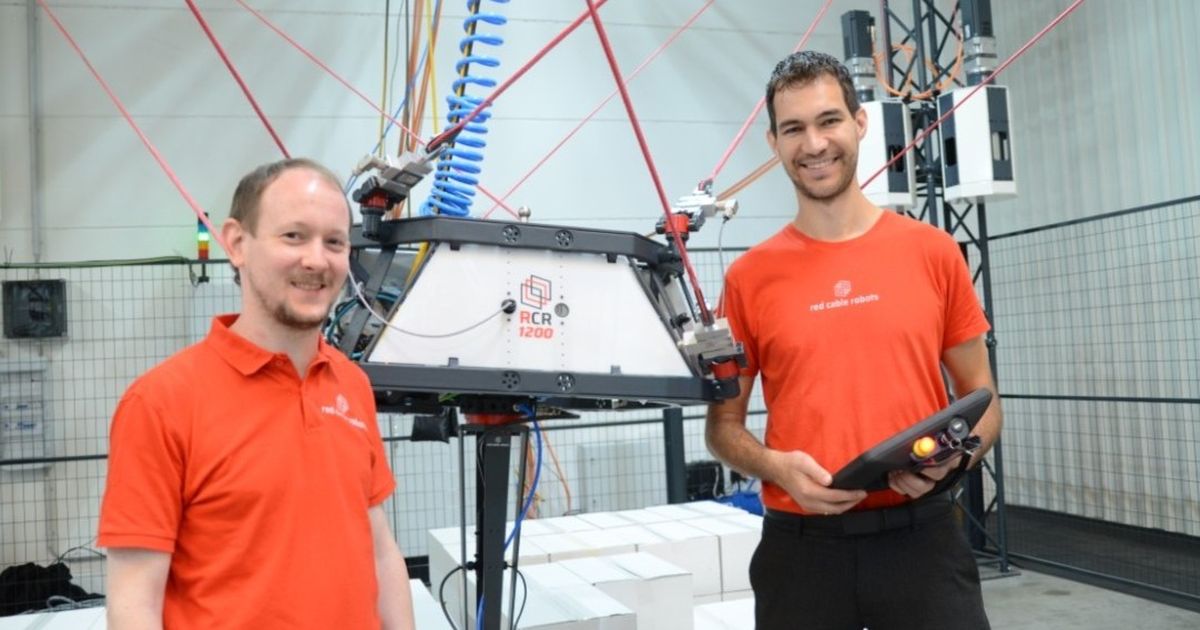
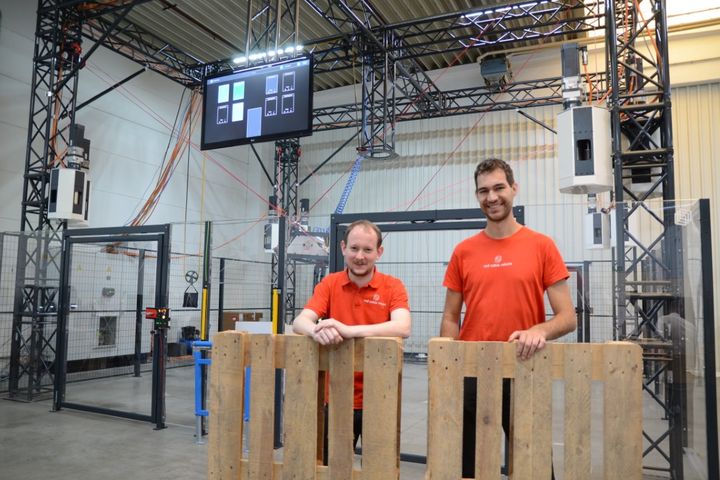
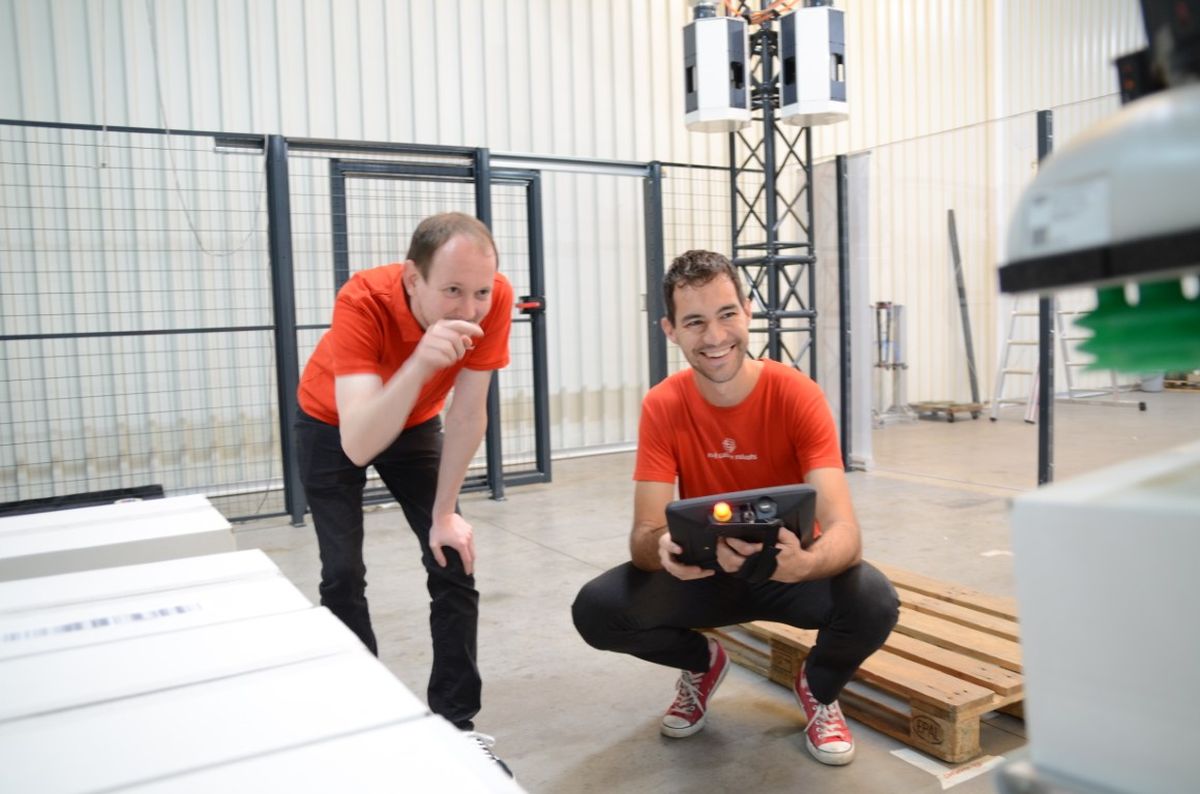
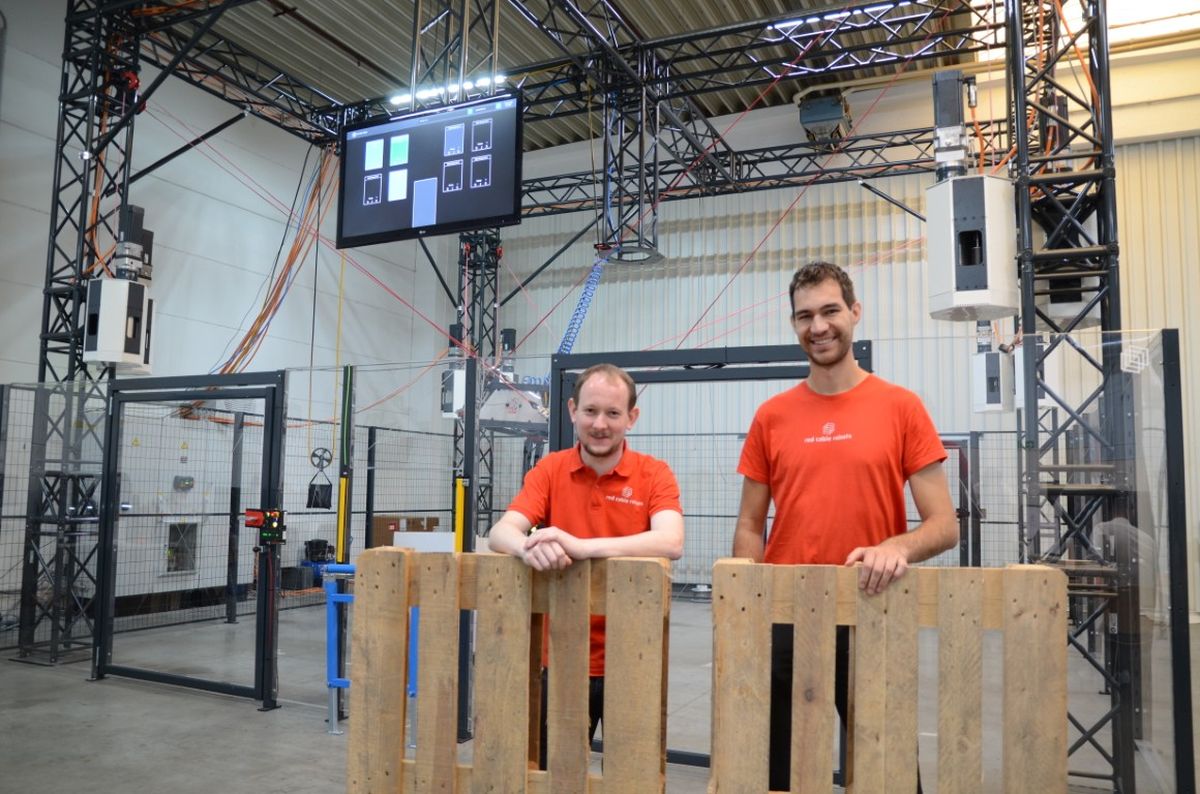
We are meeting at a spacious storage rental facility in Duisburg, where we are welcomed by Patrik Lemmen (CTO) and Robin Heidel (COO). They met at Duisburg University, where they worked as research fellows until five years ago when they left the university and started their own company together with Roland Boumann (CEO) and Tobias Burger (CCO). They come across as down-to-earth and straight-to-the-point. Their workspace exudes innovation and entrepreneurship in its purest form.
Red Cable Robots GmbH is a start-up that develops a new type of industrial robots for large-area automation tasks. Their solution, which is reminiscent of the spidercam used at sports events, has just achieved market maturity. The target industries for the company’s product include manufacturing, construction, and aerospace. Currently, the team is focusing on intralogistics processes, in particular the palletizing and depalletizing at the start and end of production lines or logistics processes.
Say what? Cables?
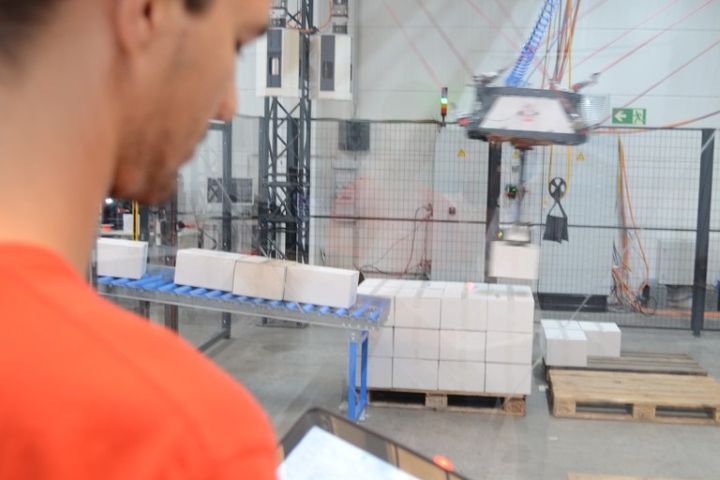
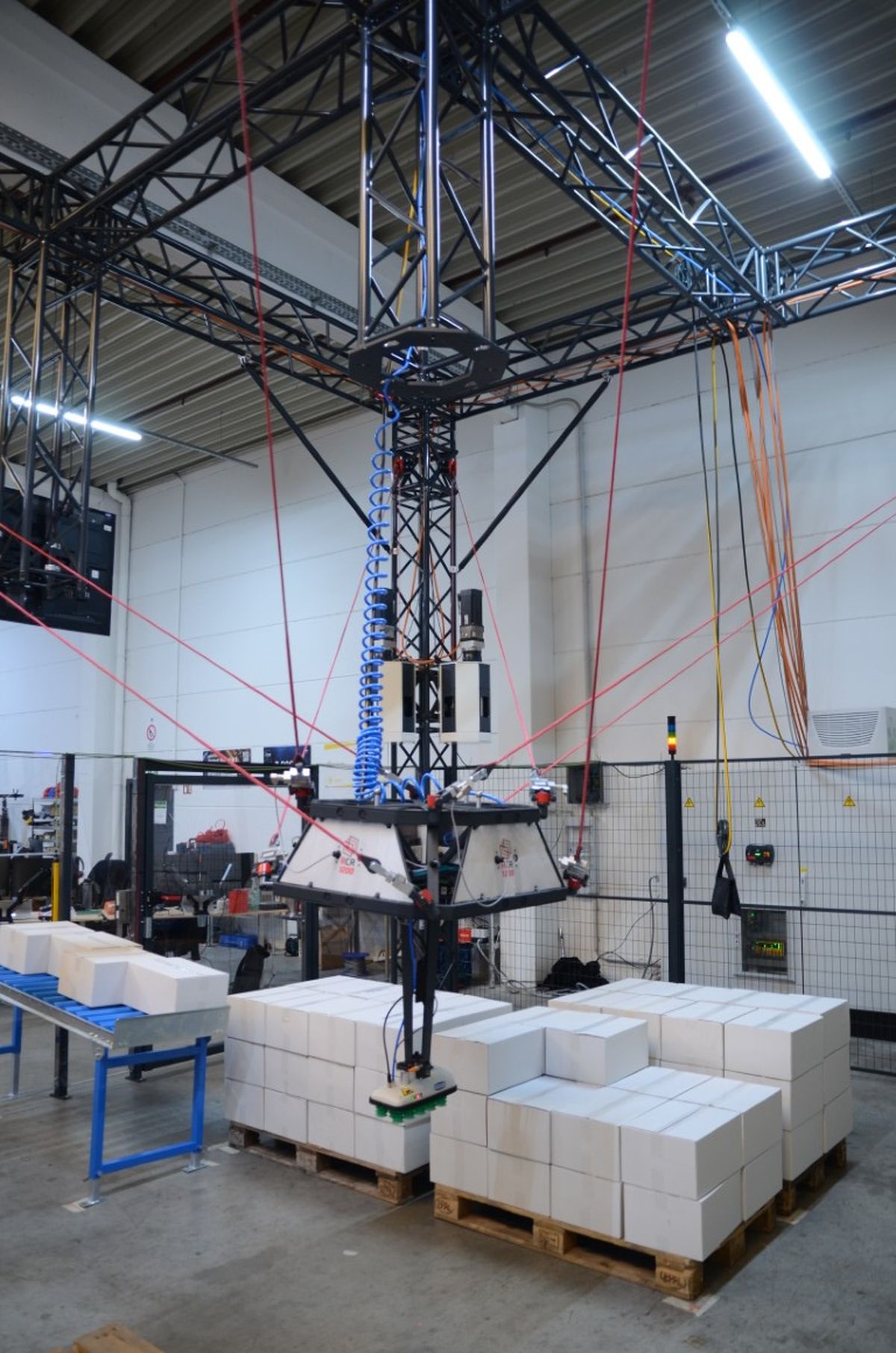
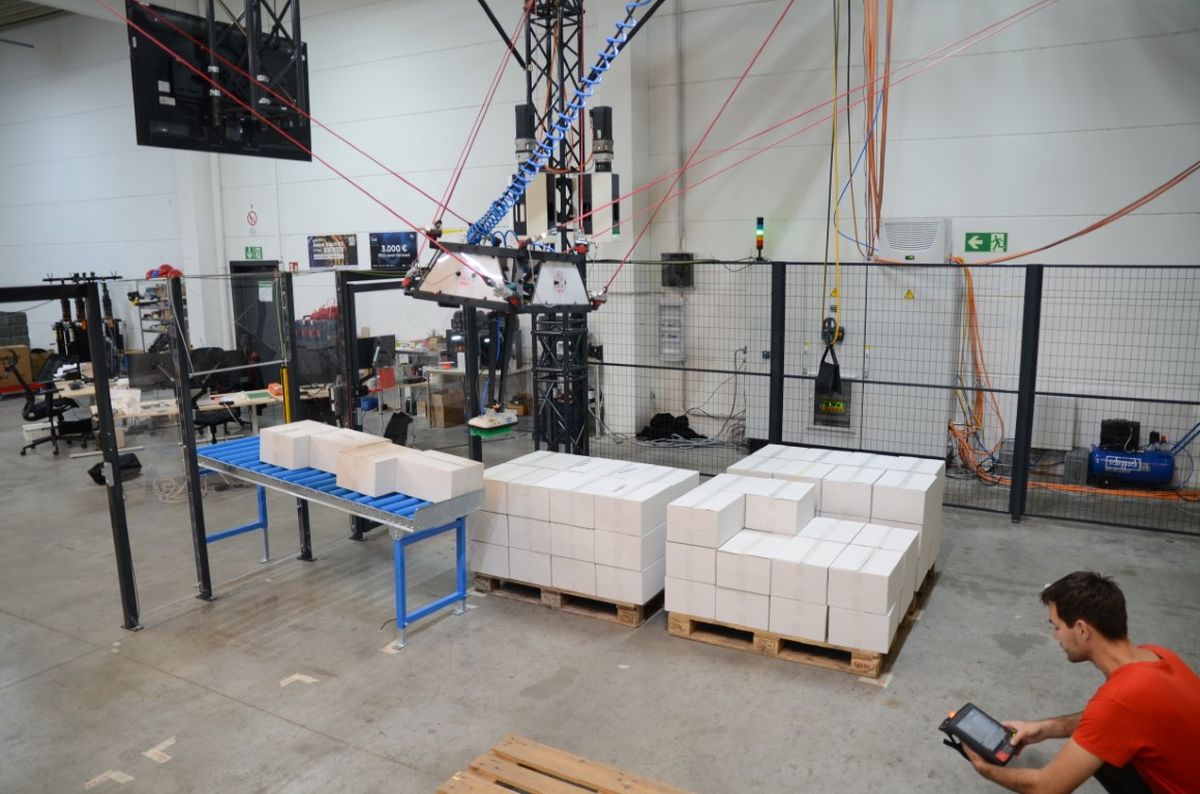
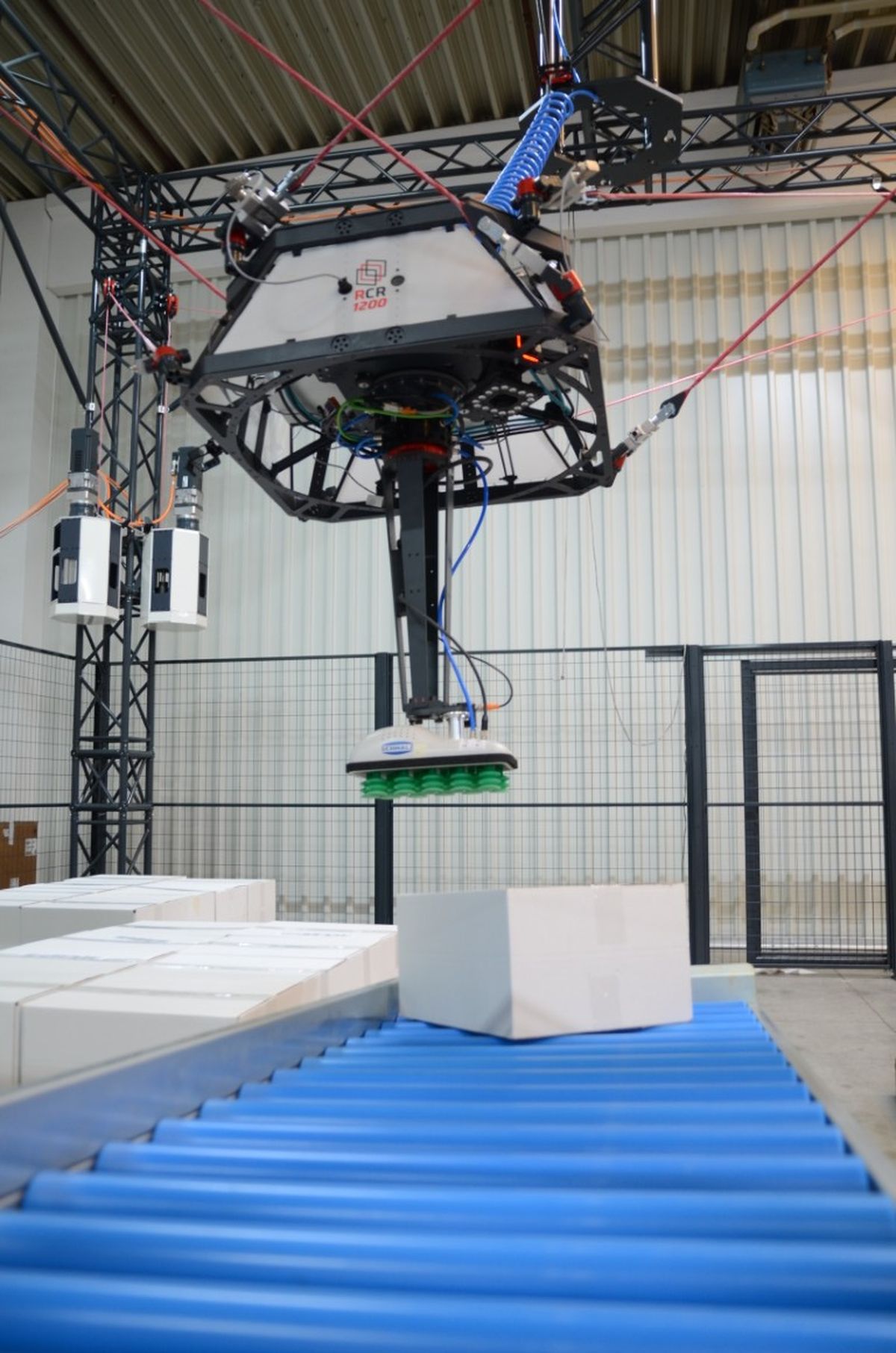
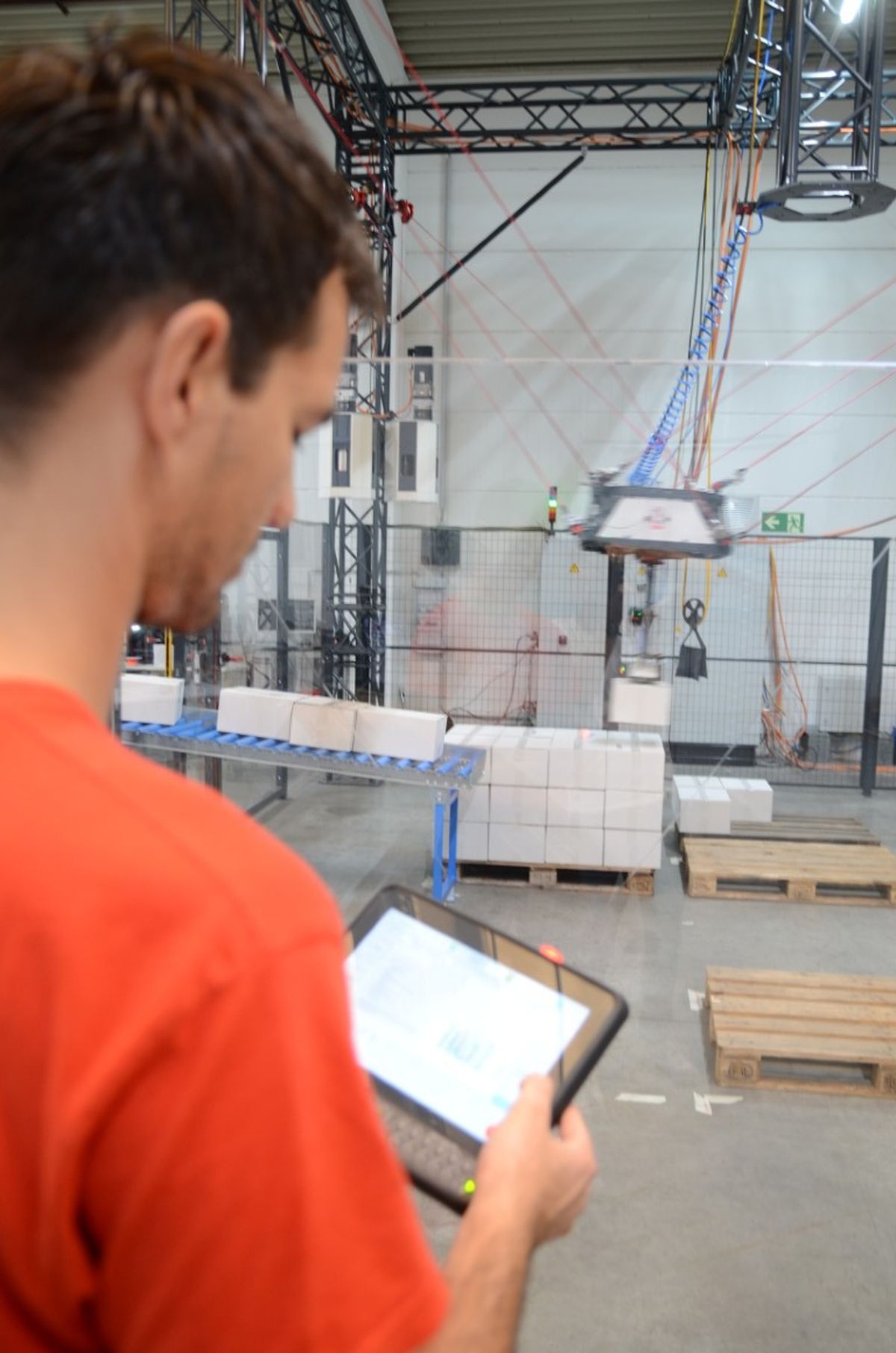
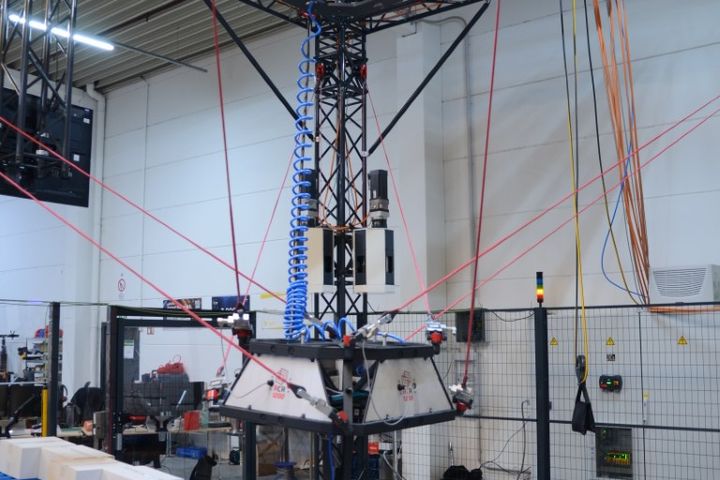
The Red Cable Robots team moves a platform about the size of a milk crate over a work space of several meters, for example over an area the size of a tennis court. Connected cables are unwound and rewound in a coordinated manner. In doing so, the robot picks up an item from one location within its work space and positions it at another location. Even though the system is moving an object suspended on cables, there is no swinging or swaying. Such unwanted movements are prevented by eight cables that are actuated with precise tensile force and provide the rigidity of the platform moving through space. This makes it possible to achieve the high dynamic and accuracy required for industrial processes. Robin Heidel: “People are always surprised by the speed and precision of the system. In our standard set-up, we achieve a precision in the millimeter range.”
The comfortable weight of the system is currently at around 25–30 kilograms per package. The maximum weight the system can handle is currently about 80 kilograms—in the central portion of the space, it can be significantly more. All standard grippers are supported; in most cases, however, vacuum grippers are used.
“When several of our robots are operating together, all systems can be controlled via a single operator panel: the KeTop Safe Wireless. That is a super efficient solution for us."

Cable robots and their benefits
Cable robots contribute significantly to greater efficiency. They can work around the clock without need for breaks, thereby increasing throughputs and smoothing peaks. Their precision reduces errors and ensures consistent results. The robots are capable of processing large quantities of goods in a very short time, thus avoiding bottlenecks and improving the production flow.
Cable robots can be adjusted to different layouts and local conditions without any development effort. They can hover above any machines on site, but can still dive down to deeper levels. Likewise, a subsequent reconfiguration or layout change, or even the dismantling and reinstallation of the system at another site, requires only little effort.
The system typically uses eight ropes (at minimum, six), allowing it to cover all six degrees of freedom in space – meaning that the platform can be tilted in a targeted manner. This is a clear advantage over gantry systems that require an additional axis, e.g. in order to pick up items from an inclined roller conveyor.
Patrik Lemmen: “Our great advantage is the handling of multiple pallets at the same time. One example is the sorting of a large variety of packages that need to be transferred from one or multiple conveyor belts to multiple different pallets—and all this by one single robot system.”
This is where the Red Cable Robots approach yields enormous cost savings compared to conventional automation solutions; in some fields, this is actually the first time that any approach can make automation cost-effective.
For example, in many logistics operations, there are applications at the branches–there are typically one to four, but some layouts include up to 40 branches. Currently, each branch requires its own robot, which is almost impossible to realize because there is currently no automation solution for systems with a large number of branches. Consequently, the work is performed manually. “Two FTEs per branch means that such a system has paid for itself after just one and a half years,” explains Patrik Lemmen.

"The possibilities offered by the HMI configurator were a great source of inspiration for operation ideas."
Another benefit is that the robot avoids pallet-change downtime because it can always take care of enough pallets as buffer zones in the work space. In addition, the automation process can be adjusted with great flexibility because the system permits quick set-up and take-town and only requires a small footprint. Robin Heidel: “We are currently planning a double cell: One part of the space is used for stacking, the other part is used for the removal of full pallets and the provision of new ones. In such a scenario, the Red Cable Robots system runs without any downtime.”
Patrik Lemmen: “The currently available solutions for logistics automation have almost achieved market saturation. The automation of new processes goes beyond the limitations of the current hardware.” Even though he considers humanoid robots an important trend, he thinks that some time will still pass before these solutions will be able to provide real business value. In addition, many automation tasks would be beyond their physical limits with regard to reach and load capacity. “Our system opens up completely new possibilities for large-area, dynamic processes, even when handling heavy weights”, says Patrik Lemmen.
Red Cable Robots prefers KEBA KeTop Safe Wireless hand-held terminals
The industrial robots offered by Red Cable Robots are typically very big and cover a large area. This creates two main challenges for the operator terminal:
It must come with certain safety features, such as an emergency off switch, and it must meet a specific DIN 13849 performance level.
The large work space means that a wireless device is indispensable. Robin Heidel: “For example when teaching the robot, we are moving in the space and must keep our eyes on the robot at all times. This would be next to impossible with a wired operator terminal.”
Faster decision making with HMI Configurator
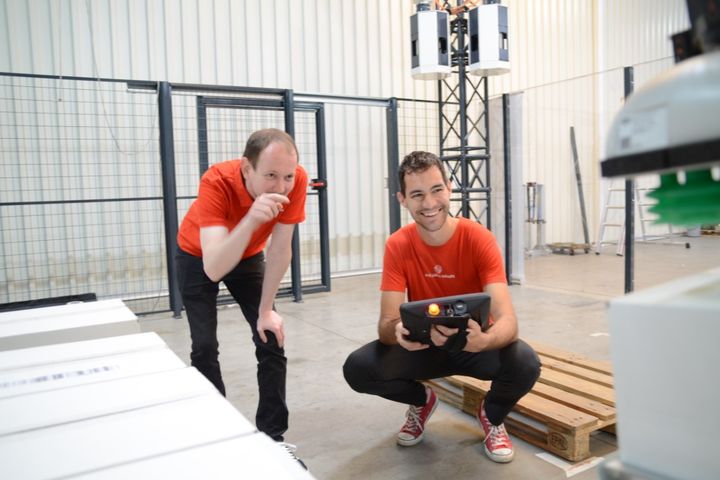
Just when Red Cable Robots approached KEBA with their inquiry, KEBA launched its online HMI Configurator. Robin Heidel: “For us, this is a super convenient solution for the custom design of our hand-held terminal. We were able to choose whether we wanted a small or a large display; landscape or portrait orientation; individual push-buttons; and much more.” In the end, Red Cable Robots settled on a customized KeTop T155 Safe Wireless device.
“Even with its large landscape display, this version handles very comfortably, so that the 3-way enabling device for programming the robot is always accessible. We are particularly pleased with our custom design with our company logo.”
The greatest challenge for the Red Cable Robots team was indecisiveness, firstly regarding the design of the hand-held terminal, and secondly regarding its optional features. “The possibilities offered by the Configurator were a great source of inspiration for operation ideas,” says Robin Heidel.
The importance of KEBA
Red Cable Robots appreciates the innovative partnership offered by KEBA. Robin Heidel: “There was no other company that offered such a flexible solution for our requirements.”
The start-up uses primarily an EtherCAT® bus system for communication within the control system. This communication protocol is used more and more often in the industrial sector. Robin Heidel: “KEBA is on the verge of launching this technology on the market in the KeTop products. We are excited and look forward to this version because it will save us quite a bit of cabling work in our control cabinet.”
For Red Cable Robots, KEBA stands for the safe and flexible operation of their systems. Says Patrik Lemmen about the importance of KEBA now and going forward: “When several of our robots are operating together, all systems can be controlled via a single operator panel: the KeTop Safe Wireless. That is a super efficient solution for us.”