


Andrei Rocha: "Today’s key skill gap isn’t just technical.”
- Digitalization
- Trainings
- 9.1.2026
- Reading Time: {{readingTime}} min

Contents
Who is Andrei Rocha?
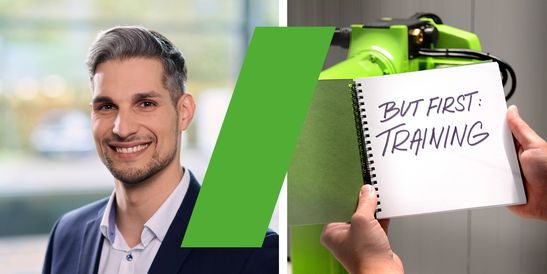
I’m a curious person who loves understanding how systems work. Since I was young, I’ve enjoyed repairing things and learning how they function. My approach to problem-solving is based on seeing the whole system as one, which helps me find effective solutions. I also believe that knowledge should be easy to share, so I value learning the fundamentals deeply in order to teach and explain them clearly to others.
How did your path lead you to KEBA?
I developed an early interest in mechatronics during a student exchange in Germany. After studying mechatronics in Bolivia, I completed a Master’s degree in Control Engineering in Germany and joined KEBA through my Master’s thesis and internship. Today, I continue to grow at KEBA, enjoying the mix of technology, teamwork, and continuous learning.
Can you reveal a fun fact or secret about yourself?
I’m far from a perfect person in every sense, and that definitely showed in math and physics back in school. My goal was never just to memorize theory; I’ve always wanted to understand why things happen the way they do. That curiosity has been one of my biggest strengths in understanding how systems truly work.
And one more fun fact: I built an electric go-kart, a project I later donated to my university, hoping to inspire and support future student projects.
What do you see as the most significant skills gap in industrial automation today?
Today, industrial automation is more interconnected than ever. Real-world experience shows that success comes from combining multiple technologies - it isn’t a single “core” technology anymore. In modern industry, professionals need an open mindset and a commitment to continuous learning to stay ahead.
Even fundamental concepts can have deep implications, so a strong understanding of basic principles is essential. Every industrial engineer should be familiar with a range of devices and understand how they function within the larger system. For example, mechanical engineers benefit from having at least a basic knowledge of programming and embedded systems, while automation specialists can gain a lot by understanding mechanical and electrical aspects.
The key skill gap today isn’t just technical; it’s the ability to integrate knowledge across disciplines and continuously adapt to new technologies.
"The key skill gap today isn’t just technical..."
"There’s no such thing as an unsolvable problem - just take it one step at a time."
What skills will be critical for automation experts in 2030?
A deep understanding of industrial communication protocols, such as OPC UA, Modbus, and others, will be essential, as connectivity and interoperability will continue to drive the future of the industry.
In addition, strong programming skills will be critical not just for PLCs, but also for custom configurations and integration with AI and advanced automation systems. Automation experts will need the ability to combine multiple technologies and understand how systems communicate.
What was the most impactful training you’ve ever attended in your career?
It was the one focused on servo drive technology, where I saw theory applied in practice - from calibrating drives to moving an axis via a Java-based HMI. It strengthened my technical skills and highlighted the importance of connecting theory with real-world industrial automation.
What’s one piece of advice you’d give to young engineers entering the field?
My advice for young engineers is to stay patient and keep an open mind. Always take the time to seek the right answer, even if it takes longer than expected. Start with the fundamentals before moving on to more complex ideas.
For example, working on a motion control project in industrial automation requires a solid understanding of programming, servo drives, and the physics behind the system. It’s also essential to learn the available communication interfaces, understand how the technology functions, and then make it all work together. Building this foundation will make it much easier to tackle advanced challenges and integrate knowledge across disciplines.