




Industrial AI: challenges, opportunities and new competitors
- Digitalization
- AI
- 1.8.2026
- Reading Time: {{readingTime}} min

Contents
The biggest obstacles to the widespread adoption of Industrial AI
In spite of rapid progress, the potential of artificial intelligence in industry goes unused in many cases (see Figure 1 below).
One reason behind this is the fragmentation of systems and data landscapes - cloud, edge and on-premises solutions are often not compatible with each other, there are no common standards and technologies are often interpreted differently.
In addition, many machine and systems engineering companies still lack the necessary AI competence. There is often a lack of specialist knowledge of data modules, machine learning methods or the integration of AI into existing control systems. Building up this expertise presents large organizational and cultural challenges to many companies.
AI is also still too rarely understood as a fixed part of product development. Data competence, software development and classic engineering disciplines must grow closer together in order to shape the technological transition with success.
But the direction is clear: with more open platforms, growing standardization and AI hardware suitable for industry, the leap from vision to broad application will become ever more tangible.
Is the lack of standardization holding back Industrial AI?
Currently, solutions are spread over a multitude of ecosystems that are mostly not compatible with each other and that come from different automation specialists as well as from machine manufacturers. This makes it difficult to integrate all of a system’s process participants into one single platform and to create a common database that could be used to harness a broad range of productivity potentials.
On the other hand, the situation also opens up opportunities: The fact that there are no standardization committees or industry associations that define standards for market actors to follow gives even smaller providers the opportunity to shine with their own independent solutions and secure themselves a strong market position.
The AI Act may not promote technical standardization directly, but it does create a clear legal framework for handling data and the use of AI systems. It ensures more transparency and legal certainty which helps smaller providers in particular develop trustworthy solutions and gain a foothold in the market.

“The challenge is to achieve greater flexibility without detriment to productivity.”
The necessary paradigm shift in machine development
Here, the requirements are moving towards customization and greater variation in production.
In other words, the challenge for automation is no longer to increase productivity by yet another notch, but to achieve greater flexibility without detriment to productivity.
This requires another development step from flexible production to skill-based programming, i.e. production based on enhanced machine capabilities.
It is primarily artificial intelligence that provides the machines with such enhanced capabilities to do certain things or to re-combine existing abilities.
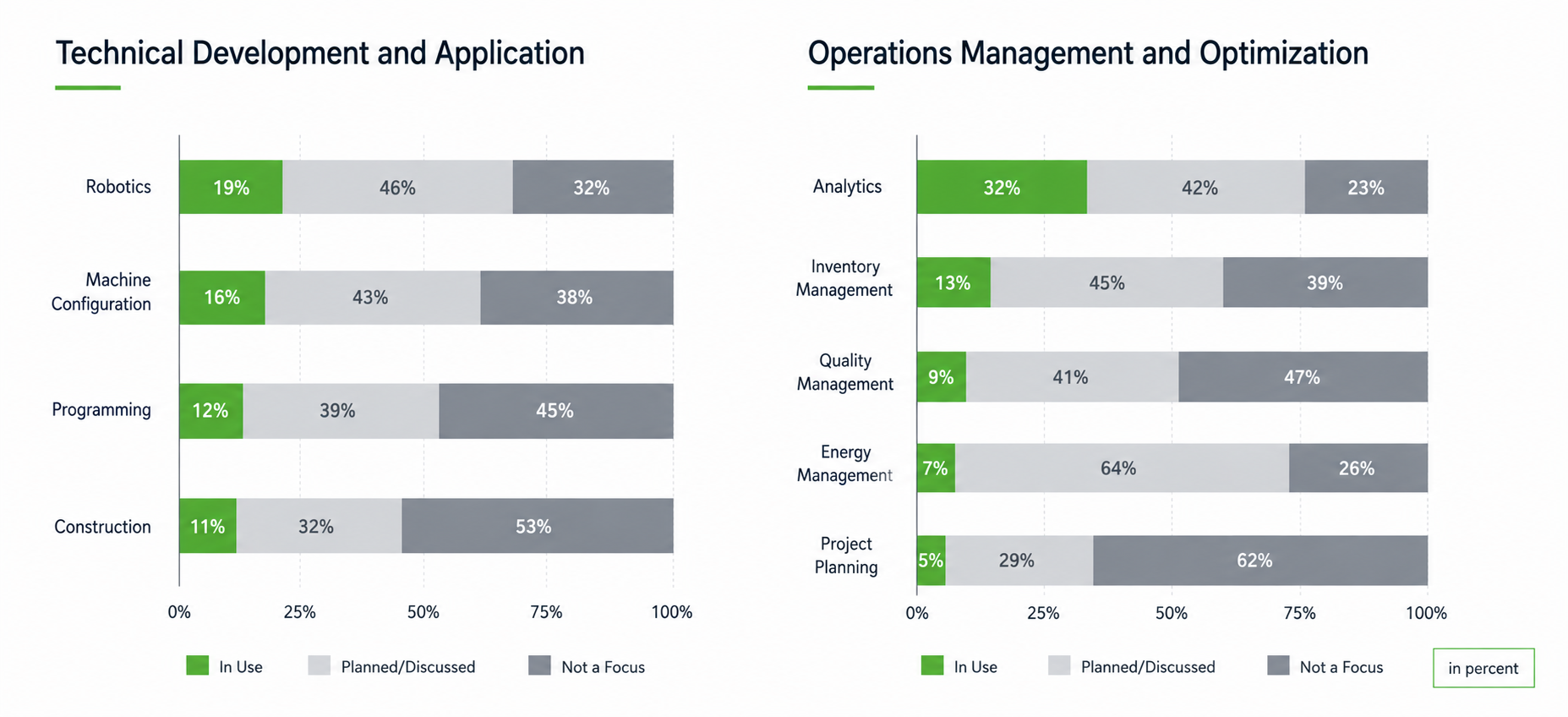
AI Adoption by Application Area in German Industrial Companies Source: Bitkom Research, 2025
Figure 1: AI adoption by application area in German industrial companies
Source: Bitkom Research, 2025
The competitive landscape is changing
Data-driven business models are gaining ever more importance and changing industrial value creation. New competitors from the IT and cloud sectors are penetrating the market and increasingly occupying key positions.
In this way, Amazon Web Services (AWS) offers platform services for IoT, data analysis and predictive maintenance today which are specially tailored to suit industrial applications. With its Azure platform, Microsoft supports the integration of cloud and edge solutions in production processes and enables quick scaling of digital services. Google Cloud is also pushing its way into production with AI-supported applications such as visual quality control and anomaly detection. With WatsonX, IBM is utilizing industrial AI solutions for process monitoring and data-based decision-making support. In turn, SAP supplements its ERP systems with AI-supported analytics, process optimization and integrated asset management.
Machine manufacturers and automation technology providers also face competition from another direction - from start-ups and artificial intelligence pioneers from outside the industry. These new companies often bring innovative approaches, dynamism and in-depth AI expertise which machine manufacturers often lack. As cooperation partners, they can provide valuable impetus or close technological gaps at short notice, for example, in developing intelligent assistance systems, predictive maintenance solutions or AI-supported data analysis.

One last must-read before your next Industrial AI initiative
Discover a practical 7-step industrail AI implementation roadmap, learn the biggest obstacles holding OEMs back, and understand how new competitors are reshaping the Industrial AI landscape - in our latest whitepaper: The meeting of artificial intelligence and Industry 4.0.
Have questions? Connect with the author.