

David Kirschner: “Curiosity, applied responsibly, drives real innovation.”
- Trainings
- Digitalization
- 16.4.2026
- Reading Time: {{readingTime}} min
Contents
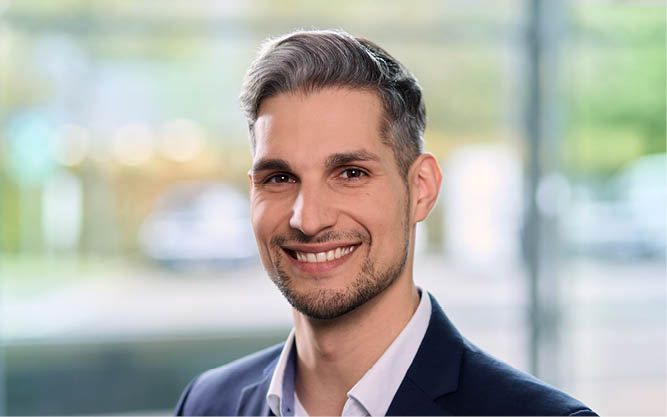
Who is David Kirschner?
I studied at the Technical University of Budapest, earning a Bachelor’s in Mechanical Engineering and a Master’s in Mechatronics with a focus on robotics. For much of that time, it felt like a bubble - surrounded by people with similar mindsets.
That changed during a semester abroad in Istanbul. It was as challenging as it was inspiring. Studying with people from across Europe broadened my perspective, strengthened my language skills, and gave me the confidence to live and work outside my comfort zone - an experience that still shapes how I approach challenges.
I began my career at a robotics research institute in Klagenfurt, working with state-of-the-art equipment, exploring new technologies, and publishing research presented at international conferences. That time sparked a curiosity I still carry today.
This curiosity fuels my ongoing drive to learn, experiment, and bring new technologies into real-world automation - something I’m proud to have been doing at KEBA for over three years. Outside of work, I’m a proud father of two young children, and most of my free time is happily spent with them. As they grow older, I hope to share with them the passion and knowledge once passed on to me.
Can you share a fun fact about you?
For many years, I competed in remote-controlled (RC) boat competitions, using the technology and knowledge I inherited from my grandfather. I won several national championships in Hungary and even had the chance to represent it at a world championship. Maybe I’ve always been competitive - or maybe those competitions made me that way (laugh)?
What do you see as the biggest skills gap in industrial automation today?
I think the biggest gap is in bridging traditional control engineering with modern software skills. Many engineers are strong in PLC programming or mechanical design, but struggle when it comes to concepts like simulation, data handling, or integrating with higher-level IT systems.
At the same time, the reverse is also true: we see very capable software developers who can code in C++ or manage DevOps pipelines, but who have little understanding of how a machine behaves in the real world. Without that context, their solutions can miss the mark on the shop floor.
The industry really needs more professionals who can combine both perspectives - engineers who are comfortable with code and with kinematics, sensors, and drives.
"The biggest skills gap is in bridging traditional control engineering with modern software skills."
"Don’t just learn how to program a PLC or robot - learn why things are done a certain way."
Which automation technologies do you think every engineer should learn first?
For me, two fundamentals stand out:
- Industrial communication & networking - the soul of automation. Machines, sensors, and systems all talk to each other, and understanding how they communicate is the key to building reliable applications.
- Control fundamentals, because today’s PLCs aren’t just simple controllers that scan inputs and toggle outputs. They’re essentially computers with powerful, customizable runtimes. Without understanding their architecture, it’s hard to really unlock their full potential.
Master these two areas early, and you’ll have a rock-solid foundation to grow into any technology that comes next.
What’s one piece of advice you’d give to young engineers entering the field?
Don’t just learn how to program a PLC or robot - learn why things are done a certain way. If you understand the principles, you’ll adapt to any platform or new technology much faster.
Stay curious: the best engineers I’ve met are the ones who never stopped asking “what if we try this?”
Yes, I know… it could also end with a famous quote. But I’ll go with my own motto: Curiosity, applied responsibly, is what drives real innovation.