


How the new KePlast Smart Functions optimize injection molding
- Plastics
- 21.7.2026
- Reading Time: {{readingTime}} min
Contents
What comes after mechanical optimization?
While modern injection molding machines have been highly optimized from a mechanical perspective over decades, further performance gains can now be achieved through improvements in control architecture.
Dead time, synchronization latency, hydraulic nonlinearities, mechanical transmission behavior, and dynamic disturbances define the real performance boundaries of today’s machines. Improving individual parameters is no longer sufficient. What is required is an integrated, layered control strategy.
KePlast Smart Functions represent exactly this approach. They are not isolated optimizations, but form a coordinated control ecosystem operating across four layers:
| Control Layer | Focus | Impact |
|---|---|---|
| Communication Layer | Dead time & determinism | Faster, more predictable reaction |
| Drive Layer | Pressure & torque dynamics | Reduced over- and undershoot, higher stability |
| Motion Layer | Synchronization & ramp behavior | Mechanical protection |
| Process Layer | Injection & positioning stability | Higher part quality |
How do KePlast Smart Functions optimize the injection molding process?
Each KePlast Smart Function addresses a specific physical limitation — but their real strength lies in how they interact and complement each other.
At the foundation, Basic Control Technologies such as Fast Reaction Control, Closed-Loop Pressure Control, Torque Follower Control, Fast Cut-Off Detection, and Fast Cross-Communication on EtherCAT eliminate architectural bottlenecks. They reduce control latency from millisecond-level delays to deterministic microsecond execution, enabling higher bandwidth and more stable control loops.
Building on this foundation, our injection-related Smart Inject functions, consisting of Dynamic Inject, Dynamic Hold, and Dynamic Plasticize, stabilize the most dynamic and quality-critical phase of the molding cycle. They ensure consistent melt flow and directly improve part weight stability and repeatability.
The mold-related Smart Mold functions, such as Automatic Ramp Calibration, Adaptive Positioning, Dynamic Pump, and Toggle Release Compensation, help correct hydraulic and mechanical nonlinearities. They reduce oscillation, optimize braking behavior, correct positioning drift, and extend mold lifetime, even on cost-efficient hydraulic machines without servo valves.
“12× shorter control response with cycle time 125 μs instead of 1.5 ms.“
Basic Control Technologies: Where high-performance control begins
The table below provides an overview of the Basic Control Technologies—the foundation for the other KePlast Smart Functions.
Together, they reduce control latency, improve synchronization, and enable faster, more stable machine operation. Their benefits range from deterministic cross-axis synchronization to high-speed pressure control and rapid cut-off detection.
As an example, by executing control functions directly at the drive level (on KeDrive D3) with cycle times as low as 125 μs instead of approximately 1.5 ms, they can deliver up to 12× faster control response compared to conventional PLC-based architectures. Discover the full technical details and measurement results in our latest whitepaper.
| Smart Function | Core Benefit | Axis Type |
|---|---|---|
| Fast Reaction Control | One-cycle control execution | Electric & Hydraulic |
| Fast-Cut-Off Detection | Accurate cut-off detection and DO switching | Hydraulic |
| Closed-Loop Pressure Control on KeDrive D3 | 125 μs fast pressure control, reduced overshoot | Electric & Hydraulic |
| Fast Cross-Communication on EtherCAT | 125 μs synchronization between axes | Electric & Hydraulic |
| Torque Follower Control on KeDrive D3 | 125 μs torque distribution across axes, drive protection | Electric |
| Position Balance Control on KeDrive D3 | 125 μs multi-axis position synchronization | Electric |
| Cut-Off Detection on KeDrive D3 | 125 μs cut-off detection and response | Electric |
How does Smart Inject deliver more consistent parts?
Smart Inject combines Dynamic Inject, Dynamic Hold, and Dynamic Plasticize to stabilize the most dynamic phase of the injection molding cycle.
Together, these functions improve melt consistency, maintain a stable cushion, and can achieve up to 35% better part-weight consistency. By continuously compensating for process variations across injection, holding, and plasticizing, Smart Inject delivers a more stable and repeatable molding process. This translates into improved product quality, reduced process deviations, and higher overall production efficiency. Learn more in the whitepaper.
“Up to 35% improvement in part-weight consistency.“
| Smart Function | Core Benefit | Axis Type |
|---|---|---|
| Dynamic Inject | Stable melting flow | Electric & Hydraulic |
| Dynamic Hold | Stable cushion | Electric & Hydraulic |
| Dynamic Plasticize | Consistent plasticizing time | Electric & Hydraulic |
How does Smart Mold optimize mold movement?
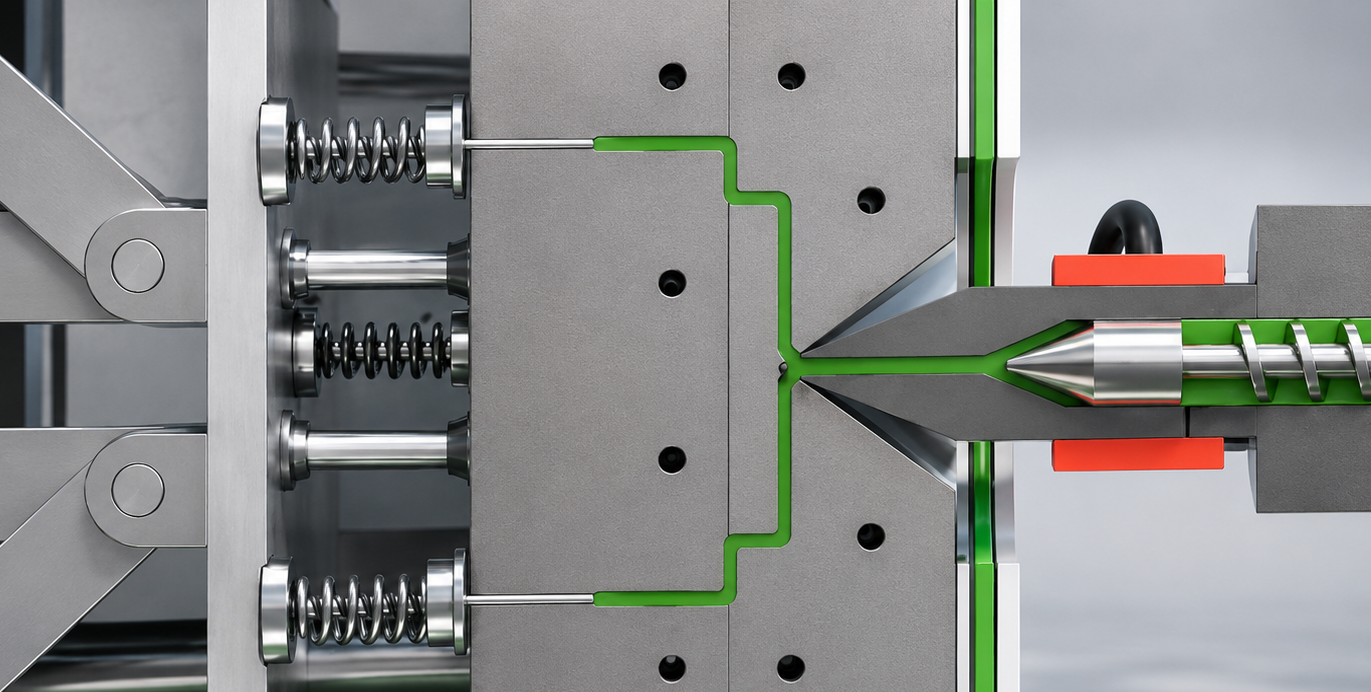
The third and final group of KePlast Smart Functions, Smart Mold, optimizes mold movement and positioning. By compensating for hydraulic and mechanical nonlinearities, these functions improve process stability, increase positioning accuracy, and reduce mechanical wear. Explore the overview below, or dive deeper into the technology in our latest whitepaper.
| Smart Function | Core Benefit | Axis Type |
|---|---|---|
| Automatic Ramp Calibration | Identifies a fast, but smooth mold ramp | Hydraulic |
| Adaptive Positioning | Accurate mold stop position and inter-stop positions without servo valve | Hydraulic |
| Dynamic Pump | The toggle lever’s actual speed follows the set speed more accurately | Hydraulic |
| Toggle Release Compensation | Reduces toggle lever open movement “bang” | Hydraulic |
Overall benefits at a glance
- Reduced pressure overshoot and faster stabilization
- Millimeter-exact mold positioning without additional hardware
- Multi-axis synchronization within 125 μs
- Reduced oscillation and mechanical stress
- Improved repeatability across production cycles
- Higher drive utilization and lower thermal load
Conclusion: The next performance breakthrough starts with intelligent control
Mechanical optimization has taken injection molding a long way. Intelligent control takes it further.
KePlast Smart Functions transform control architecture into a competitive advantage, enabling faster response, greater precision, and more consistent production across the entire injection molding process.
The images in this article were edited using AI.