




Industrial AI: key market trends and where AI creates value
- Digitalization
- AI
- 23.7.2026
- Reading Time: {{readingTime}} min

Contents
The numbers are in: Industrial AI is real, but most of its potential remains untapped
According to the current Industry 4.0 study report from Bitkom, 82% of the industrial companies surveyed emphasize that the use of AI will be crucial for their ability to compete in the future (Bitkom). At the same time, 42% of those surveyed stated that they lack the expertise to incorporate AI into their processes effectively. Only 24% of the companies believed that they have already succeeded in utilizing their AI potential - the majority (72%) sees a need to catch up (Bitkom).
These figures demonstrate: Awareness is high, but the practical implementation is still in its early stages in many places. AI adoption is also growing across Europe.
According to Eurostat, the number of companies using at least one AI technology increased significantly in all EU countries compared to 2023 (European Commission).
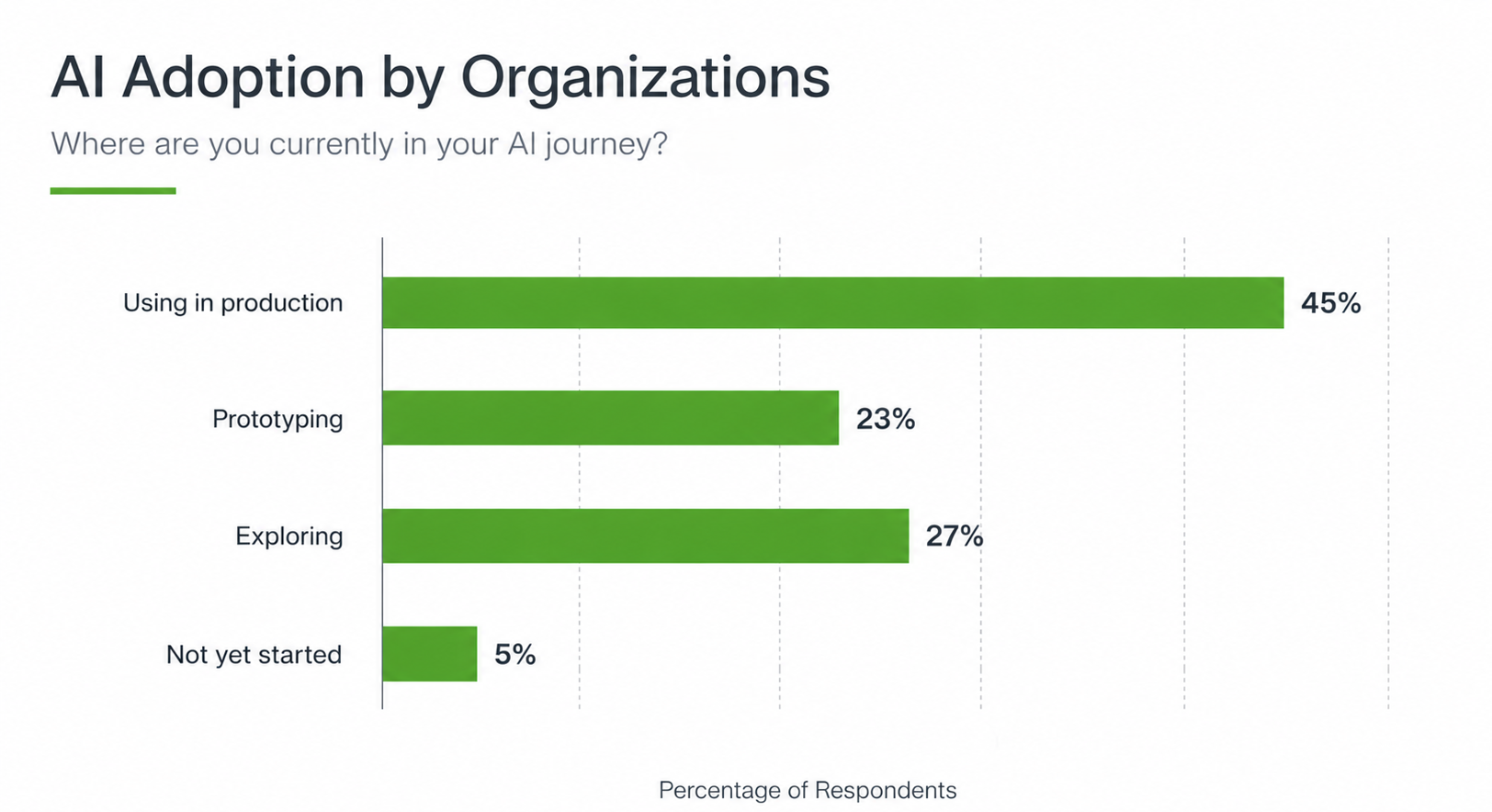
In a more global perspective, the Artificial Analysis AI Adoption Survey shows that 45% of the surveyed organizations are already using AI in production (i.e. not just in pilot schemes), meaning that the use of AI has gone beyond the exploring phase (artificialanalysis.ai).
Understanding the 3 categories of Industrial AI
In this context, three central AI application categories for industry can be derived:
1) Vision & image processing (quality inspection, object recognition, position detection)
This category covers applications in which visual data is processed directly:
- Inspection of surfaces for faults, cracks or deviations
- Localization of parts / position sensing
- Object recognition for sorting or classification
These kinds of tasks benefit greatly from Edge AI, as latency, bandwidth and real time capability are important. Many solutions run directly on the controls or on connected AI accelerators.
2) Process optimization & adaptive control
Here, the focus is on data integration from ongoing operations:
- Real-time adjustment of parameters (e.g. rotational speed, feed rate)
- Control based on historical and current sensor data
- Closed-loop optimization (systems learn to adjust themselves)
In this category, there is often added value in small, incremental improvements which add up cumulatively to significant increases in efficiency.
3) Prognosis & analytics (predictive maintenance, energy forecasts, anomaly detection)
The third category targets forecasts and more in-depth analysis:
- Prediction of breakdowns or wear (predictive maintenance)
- Pattern recognition and anomaly detection in time series
- Energy, load or stress predictions
- Simulation and scenario analysis
These applications frequently do not run in real time on the controls itself; instead, they occur on analysis or cloud components alongside operations, provided the data quality, connectivity and safety are ensured.

Which Industrial AI category should OEMs focus on?
The right category depends on where you create the greatest value. In practice, many cases show a hybrid solution that goes beyond these categories:
- An AI model for inspection (category 1) provides data which influences process optimization (category 2)
- At the same time, analysis data (category 3) can be used to derive long-term strategies
The key is not in the categorization alone, but in the integration and scaling beyond these levels.
This is the only way that a consistent, intelligent system can emerge—one which can access image recognition, real-time control and forecast analytics at the same time.
One last must-read before your next Industrial AI initiative
Discover a practical 7-step industrail AI implementation roadmap, learn the biggest obstacles holding OEMs back, and understand how new competitors are reshaping the Industrial AI landscape - in our latest white paper: The meeting of artificial intelligence and Industry 4.0.
Have questions? Connect with the author.