



How KePlast Smart Inject improves part consistency
- Plastics
- 4.8.2026
- Reading Time: {{readingTime}} min
Contents
Why even optimized injection processes still fluctuate
The injection process is the core of every injection molding cycle and has a direct impact on part quality, repeatability, and overall machine performance. However, even well-optimized machines are subject to systematic deviations across cycles.
These fluctuations can be caused by changes in ambient temperature, humidity in the production hall, or variations in material properties—for example, when processing recycled materials.
To achieve consistent results, these process variations must be addressed directly within the injection sequence.
Typical process limitations include:
- Deviations between set and actual injection velocity
- Overshoot and unstable behavior during injection ramp-up
- Cycle-to-cycle variations in plasticizing
- Inconsistent thermal conditions of the melt
- Fluctuations in minimum screw position (cushion)
How Smart Inject stabilizes the injection process
Smart Inject consists of three complementary functions that directly address these process-related limitations:
Dynamic Inject – continuously improves injection accuracy through cycle-based learning
Dynamic Hold – ensures a stable cushion, directly improving part weight consistency
Dynamic Plasticize – stabilizes plasticizing time and ensures consistent melt conditions
| Smart Function | Core Benefit | Axis Type |
|---|---|---|
| Dynamic Inject | Stable melt flow | Electric & Hydraulic |
| Dynamic Hold | Stable cushion | Electric & Hydraulic |
| Dynamic Plasticize | Consistent plasticizing time | Electric & Hydraulic |
What performance improvements Smart Inject delivers
Tests on an actual customer machine clearly demonstrate the impact of Smart Inject functions. Without Smart Inject, the process shows noticeable fluctuations in part weight and key process parameters. After activation, the results become significantly more stable and consistent.
This leads to measurable improvements, including:
- 35 % better part weight accuracy
- 75 % improved minimum screw position accuracy
- 48 % improved injection time consistency
- 53 % improved plasticizing time stability
These result in a robust and highly repeatable molding process.
The part weight comparison below illustrates the measurable improvement in process stability before and after Smart Inject activation.
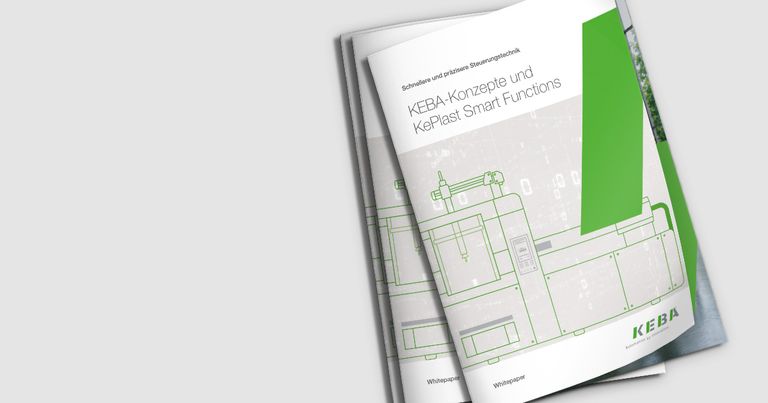
Want to explore the technology in greater depth? Download our latest white paper to discover all three Smart Inject functions, including their engineering principles, measurement results from real injection molding machines, and additional graphs and analyses.
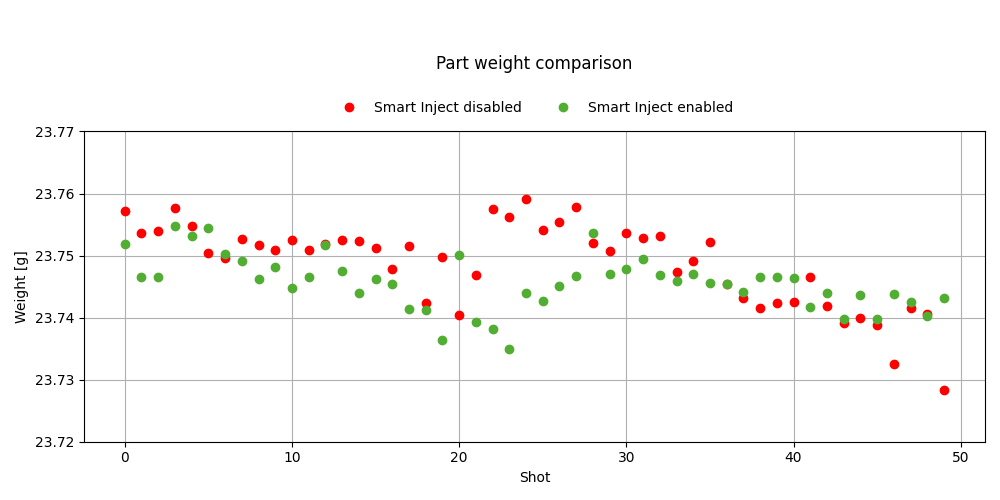
“Up to 35% improvement in part-weight consistency.”
How small system-level improvements drive big process-wide impact
While each Smart Inject function addresses a specific process-related limitation, their combined operation provides the following system-level capabilities:
- Stabilized injection velocity and reduced deviations
- Consistent plasticizing behavior and homogeneous melt conditions
- Stable cushion and reproducible holding phase
- Reduced process fluctuations and minimized oscillations
- Improved interaction between injection, holding and plasticizing phases
Overall benefits at a glance
- Higher part weight consistency and product quality
- Increased process stability and repeatability
- Reduced scrap and process deviations
- Improved overall production efficiency
Conclusion: Stable processes. Consistent parts. Higher productivity.
Smart Inject transforms the injection process into a coordinated, self-optimizing system that minimizes process variation and maximizes repeatability. The result is consistently high part quality, lower scrap rates and greater production efficiency.