


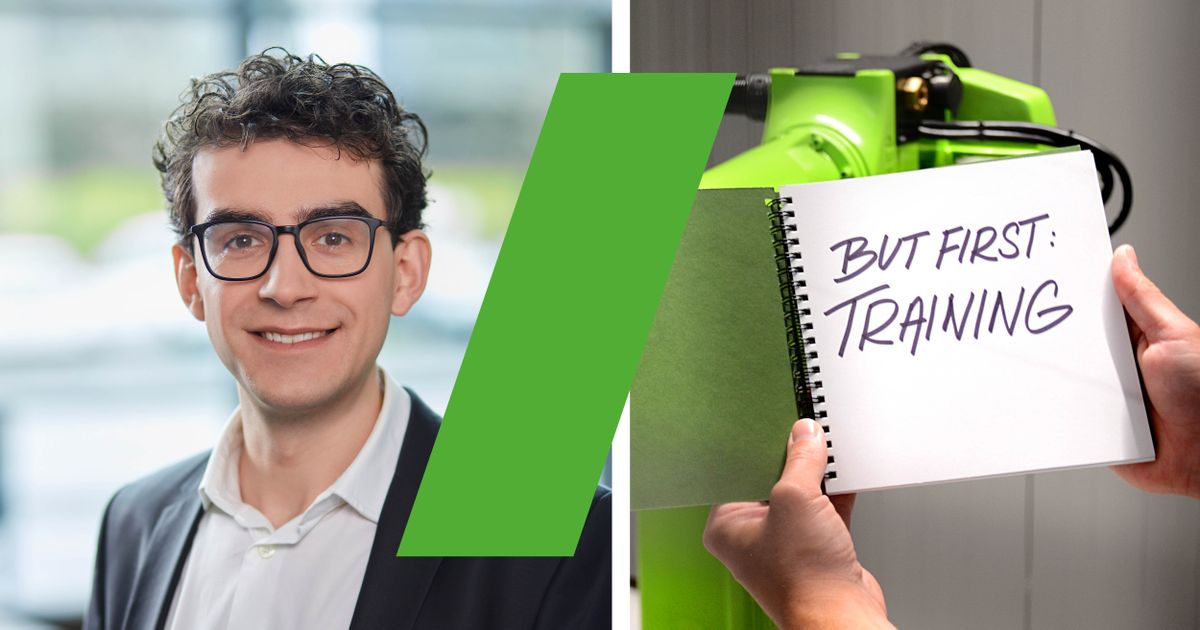
Stefan Schlömmer: “After our training, you can work safely and confidently.”
- Trainings
- 28.5.2026
- Reading Time: {{readingTime}} min
Contents
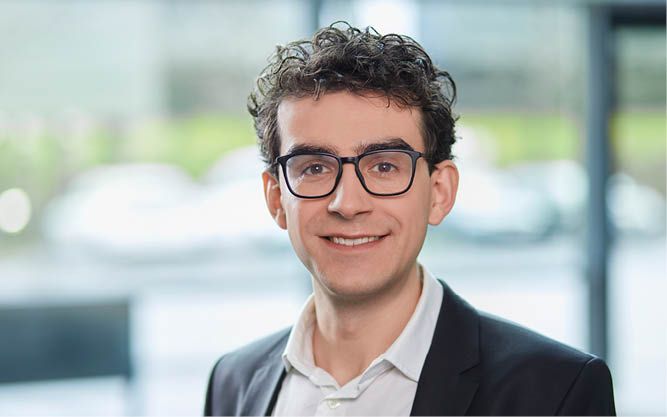
Who is Stefan Schlömmer?
As a product expert for drive technology at KEBA, I focus on making knowledge about our drive products and their applications clear, accessible, and easy to understand. What fascinates me most is control engineering: how simple principles can lead to powerful results, and how precisely the behavior of technical systems can be described mathematically.
I grew up near Linz, where my curiosity for technology was sparked early – driven by constant “why?” questions and hands-on tinkering with family and friends.
During my mechatronics studies at JKU Linz, I often helped fellow students understand technical concepts. That’s when I discovered how much I enjoy turning complex ideas into something clear and engaging – and inspiring enthusiasm for technology.
Outside of the office, running, nature, and the mountains help me stay grounded. This balance of analytical thinking and a down-to-earth mindset also influences how I work as a trainer.
How did your path lead you to KEBA?
I joined KEBA after graduating in 2022 and have since developed a strong understanding of drive technology across various industries. This experience also shapes my approach to training, combining solid product knowledge with practical insights.
My goal is simple: not just to inform, but to help participants truly understand how to apply our solutions effectively.
In your opinion, what is currently the biggest skills gap in industrial automation?
Operators, commissioning engineers, and application engineers do not all need the same level of knowledge – and that’s perfectly fine. However, a stronger basic understanding of control engineering, electronics, and drive technology is particularly valuable for application engineers and users who parameterize drives or intervene deeply in systems. This knowledge helps identify errors faster and prevents accidents and operating mistakes. That is why in my trainings, I focus on these fundamentals – taught in a practical, accessible way that supports responsible system handling.
"This knowledge helps identify errors faster and prevents accidents and operating mistakes...."
"After the training, you know how to continue working safely and confidently."
What is the most difficult thing about applying new knowledge from training courses to your daily work?
I think the biggest challenge is transferring what you have learned to your own individual systems and applications.
Every machine, every architecture, and every industry has its own characteristics – and there are no universal solution templates for this. I also think it's important to say clearly that training alone does not immediately enable anyone to be completely independent – and that's totally normal. Precisely because drive technology is so extensive, it would be neither sensible nor possible to cover everything. The key thing is that after the training, you know how to continue working safely and confidently.
What skills will be crucial for automation experts in 2030?
In the coming years, automation systems will be increasingly characterized by AI-supported robots and adaptive, learning production environments that can adapt in real time and act flexibly.
This will result in the following core competencies:
- Basic knowledge of control engineering and dynamics - necessary to be able to correctly assess and parameterize the behavior of automation systems. A deep understanding also protects against accidents!
- Safe and responsible use of AI functions - for example, the first injection molding machines are already adjusting process parameters based on AI to optimize quality.
- Basics of cyber security - global regulation and networking increase system security requirements. Technical expertise in CRA is becoming a basic requirement in the automation industry.
- Ability to quickly educate oneself - rapid technological development (AI, robotics, edge AI) makes engineers' ability to learn and adapt a key skill.