

How multi-camera tracking with KeBob enhances situational awareness and safety in self-service areas
- 5.10.2026
- Reading Time: {{readingTime}} min
Contents
Self-service areas in bank branches are often accessible around the clock. Customers can carry out their banking transactions outside regular opening hours, benefiting from considerable flexibility and short waiting times. At the same time, operating self-service areas places specific demands on security, data privacy and the user experience. Customers should be able to carry out their banking transactions quickly and easily while feeling safe and well supported. Traditional video surveillance can provide an important foundation by monitoring activity in defined areas. For an intelligent assistance solution, however, it is essential to look beyond individual camera views and understand movements and connections across the entire foyer.
What happens when a person moves from one camera’s field of view to another? And how can a system determine whether several people are together or moving independently through the branch? We developed KeBob’s multi-camera tracking specifically for situations like these.
“A more comprehensive view of what’s happening in a bank's self-service area, begins with understanding movements and connections across camera boundaries.”

Why one camera is usually not enough
A conventional camera typically operates within its own field of view. A person detected within that view is assigned a digital ID. However, if the person leaves the camera’s coverage area and then appears in front of another camera, that camera may identify them as a new person. The connection between the two observations is lost.
This type of surveillance is often sufficient for individual areas that are small and easy to monitor. In larger branches or self-service areas with more complex layouts, however, such solutions reach their limits. Multiple cameras are needed to cover all relevant areas.
Multi-Camera Tracking: Understanding Movements Across Camera Boundaries
"KeBob makes it possible to track movements across camera boundaries, identify patterns, and design security measures with greater precision."
KeBob’s multi-camera tracking makes it possible to associate the same person across multiple cameras and monitored areas. Rather than registering a person anew whenever they move from one camera to another, the system assigns them the same digital ID in the new field of view, allowing it to continue tracking them.
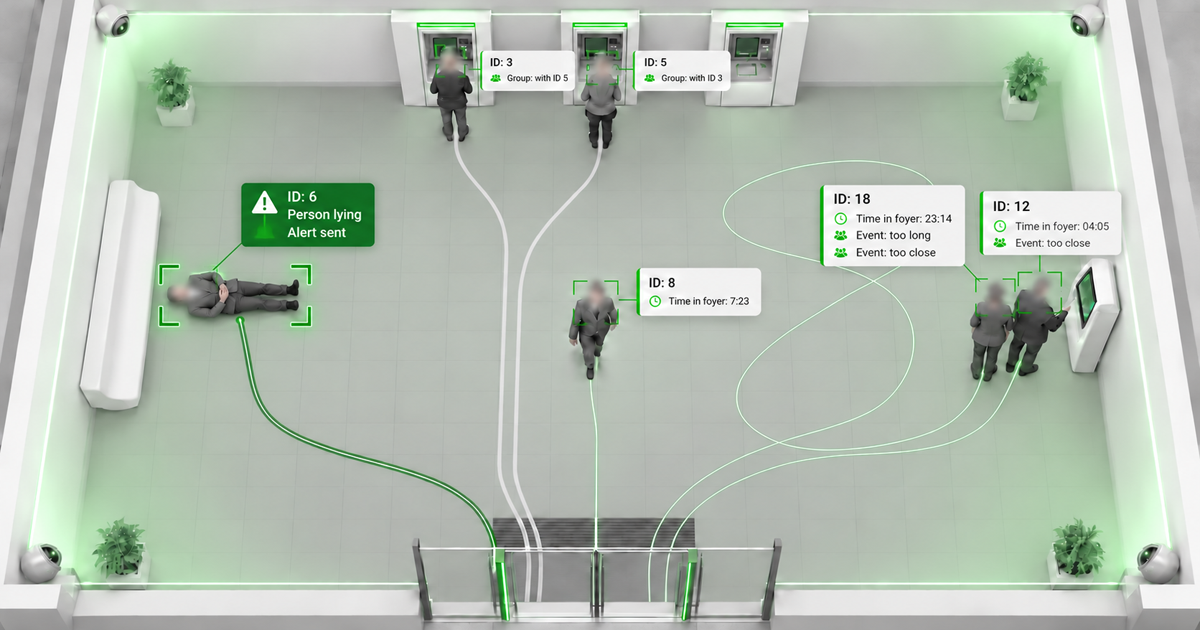
This provides a much stronger basis for assessing situations in self-service areas. For example, KeBob can recognise that a mother and her child entered the self-service area together. This group association is maintained even when they move into another camera’s field of view. This is important for correctly assessing distances and movements. After all, being close to another person does not automatically indicate suspicious behaviour. To enable this, the cameras are aligned with one another, and a shared, global coordinate system places the monitored areas in a common spatial context.
This allows KeBob to track movements across multiple camera views and understand situations in their spatial context, rather than simply analysing isolated snapshots. The result is a more comprehensive picture of what is happening in the self-service lobby – an important foundation for reliably assessing situations and responding appropriately.
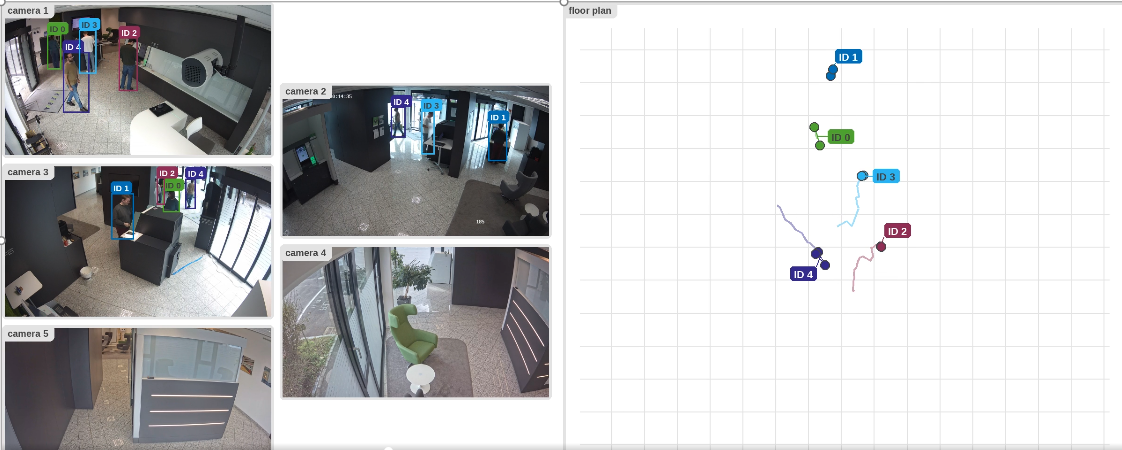
Multi-camera tracking with KeBob means tracking movements across camera boundaries, identifying connections, and designing security measures with greater precision.
KeBob keeps track of the big picture—even when people move out of the camera's field of view.
Better assess situations and respond appropriately
A concrete example when it comes to security and well-being is what’s known as “shoulder surfing”: This is when a person tries to watch another customer’s keystrokes or behavior at an ATM to spy on their PIN. While a single camera can detect that there are multiple people in the frame, it cannot assess how these people relate to one another or whether they might be part of the same group.
By cross-referencing individuals and groups across multiple cameras, KeBob can assess such situations in greater detail. If one person approaches another later on and comes within the designated distance, KeBob can address them and ask them to maintain a safe distance.
Depending on the situation and configuration, additional security measures can be activated or defined alert processes can be triggered. The goal is to create an environment where customers feel safe and comfortable when using self-service options. In this way, KeBob supports a key prerequisite for the acceptance of automated banking services.
Tailored solutions beyond standard features
Many video surveillance systems now offer person or object detection. Measuring how long someone remains within a camera’s field of view is also a common feature. The key difference, however, lies in how these functions work together and how they are adapted to the requirements of a specific location.
Computer vision and artificial intelligence do not automatically deliver reliable results simply because they are integrated into a camera system. An effective solution requires training data, testing under real-world conditions and continuous development based on the results. Factors such as the layout, potential obstructions including self-service terminals, columns and plants, different viewing angles and lighting conditions all need to be considered. KeBob is therefore developed and configured for each branch individually, with its specific application in mind.
A foundation for future analytics capabilities
Multi-camera tracking also provides the foundation for more advanced analytics capabilities. The ability to associate people and their movements across multiple cameras will enable future analysis of customer flows and movement patterns throughout the branch:
Heatmaps can, for example, show where customers spend the most time.
Movement analysis provides insights into how people navigate a lobby and which areas attract more or less foot traffic.
Compared with viewing individual camera feeds in isolation, this creates a more comprehensive picture of how a self-service area is used.
Conclusion: From individual camera views to the full picture in the lobby
For a self-service zone to be truly secure, all relevant areas must be reliably monitored. Individual cameras quickly reach their limits because each one can only capture a limited portion of the lobby.
KeBob’s multi-camera tracking expands the view of what’s happening in the self-service lobby: Instead of viewing situations exclusively within individual camera frames, KeBob can track movements and relationships across multiple areas.
This allows situations to be assessed in greater detail and triggers defined responses in a more targeted manner.
For banks and savings banks, this provides an intelligent assistance system that not only recognizes individual events but also creates a better understanding of what is actually happening in the lobby. This helps to make self-service areas safe, pleasant, and reliable.
Would you like to find out what KeBob can do for your branch? We would be happy to advise you!