



How did the first Packstation actually come about?
- News
- Knowledge
- 18.12.2025
- Reading Time: {{readingTime}} min
Contents
Part of the journey from the start
In 2001, this idea became reality, marking the beginning of a development that would go on to shape the everyday lives of millions of people around the world. Today, parcels are sent to and collected from parcel lockers every day, as if it had always been this way.
But what truly makes KePol special is not just the technology - it is the people who believed in it, then and now.
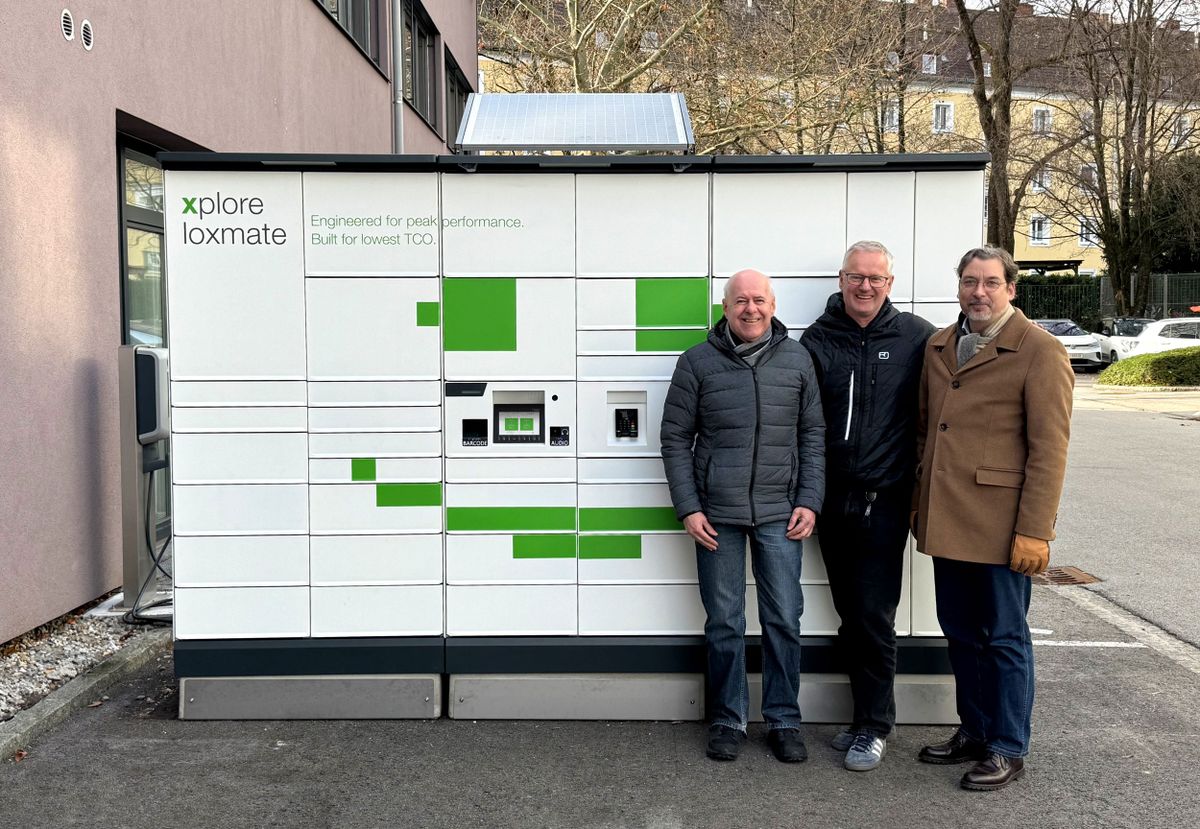
Albert Kastner, Claus Peham, and Michael Mayer are three of the colleagues who have been part of the project from the very beginning.
The prototype that started it all
Just a few weeks before the pilot launch, the first prototype was built within six weeks in a small workshop in Linz, together with a Swiss partner company.
At the presentation in Bonn, several companies competed side by side. KEBA was the only one able to demonstrate a working online connection: not a showcase, but a system operating in real time.
“Our software was running in real-world operation and that impressed DHL. That was the moment everything changed. KEBA was awarded the contract for the pilot installations, and the adventure began.”

Shaping the future
In autumn 2001, the first KePol parcel lockers were installed as pilot systems in Dortmund and Mainz. For the young team, this was a true test of limits: new technology, new processes, and a great deal of improvisation.
Dortmund quickly revealed what pioneering work really meant. Streets were torn up, the fully assembled unit arrived on a truck and there was no way to unload it. So a forklift was organized on the spot, the station was dismantled at the site, carried into the building piece by piece, and reassembled there under intense time pressure.
“I had only been on the team for a few weeks and suddenly I found myself right in the middle of the very first installation. That was real pioneering work.”

After completing the station in Dortmund, the team set off for Mainz in the middle of the night — only to turn back halfway because the insulation mats had been forgotten. A Herculean effort, but one that paid off.
In the end, they stood there: the very first parcel lockers.
A milestone that laid the foundation for an entire industry.
“Back then, we didn’t know we were making logistics history. But we could feel that something big and new was taking shape.”

Pressure that brings people together
In 2004, the rotation system project followed: a technical and organizational tour de force. New motor controls, upgraded safety systems, extensive software adaptations, and extreme time pressure pushed the team to its limits.
“We were at our limit. But we made it because we stuck together,” Claus recalls vividly.
Weeks were filled with nights of troubleshooting, improvisation, and continuous development. One moment, in particular, stood out: when the DHL project manager personally congratulated the team — right in the middle of a phase when everything was happening at once and nerves were stretched thin.
“That’s when you knew: we did a lot of things right,” Claus remembers.
Learning and growing
With every new station, a new chapter opened. KePol went on a journey to Russia, Egypt, Australia, Singapore, Dubai, Japan, and across Europe.
“Sometimes the market wasn’t ready but we were,” Albert recalls.
Different conditions and cultures, and very different ideas of how logistics should work. Not every deployment was a complete success, but every station delivered valuable experience.
“The close collaboration with our customers was crucial. Together, we learned what really matters in the field and developed a system that is now successfully deployed around the world.”
Out of all these experiences, a system emerged that is now at home all over the world: reliable, proven, and in daily use for millions of parcels.
“I’m proud to have been part of it since the very first days. Back then, we could never have imagined how big this would become. But it feels good to know that we were part of it from the start", tells Michael.
Moments to remember
An 86-year-old woman in Cologne, beaming when the parcel locker was installed because she no longer had to walk to the post office.
A DHL project manager who had a locker opened ten times just to capture the perfect smile on camera.
In Russia, astonishment all around when a local worker carried a 180-kilogram cabinet up a staircase entirely on his own.
In Dubai, work was only permitted at night, inside a separated wooden enclosure with outside temperatures reaching 40°C.
A Chinese delegation enthusiastically retrieving Mozart chocolates from the locker until not a single one was left.
The following moments are especially memorable to the colleagues
This is KePol: Technology meets humanity. Precision meets improvisation.
The path to efficiency
In the early days, installing a parcel locker took many hours. Every screw was fitted individually, every detail adjusted by hand. But with each new generation, the systems became slimmer, more modular, and more intuitive to install and service.
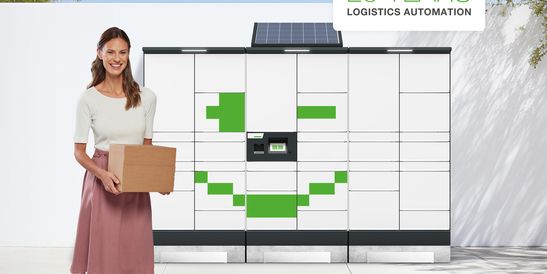
With loxmate, the latest generation, the biggest leap has been achieved: today, installation takes just 15 minutes: an impressive symbol of 25 years of innovation.
“The system kept getting better over the years. Today, we can set it up in minutes — back then, it took a full day,” Claus explains.
From pioneering work to everyday use
Today, the parcel locker is taken for granted. People open a compartment, collect their parcel, and move on without giving it a second thought.
“When you see customers using the doors exactly the way we designed them back then - intuitively and naturally - you know you got it right.”
That is precisely where the success lies: what once needed explanation is now taken for granted.
New technologies, changing user needs, and new forms of delivery will shape the future. But one thing remains constant — the heart of KEBA parcel lockers: the ambition to make handovers simpler, give people back time, and make logistics more human.
A quarter of a century later
Today, 25 years after the first installation in Dortmund, KePol stands for more than technology. It stands for a large team, passion, and the power of innovation.
Perhaps that is the real secret. No product becomes great through perfection alone, but through people who dare to make mistakes, learn from them, and keep moving forward.
“We must never stand still. Every decision is just the beginning and sometimes it leads further than you could ever imagine.”
And somewhere in the world, someone is opening a locker.
A soft click.
A parcel comes into view.
A smile.
For Claus, Michael, and Albert, one thing is clear: the story is far from over.