


Make the most of the GHG quota and ePremium – here’s how it works
- Business
- Charging
- 3.8.2023
- Reading Time: {{readingTime}} min
Contents
Do you use an electric car for personal journeys?
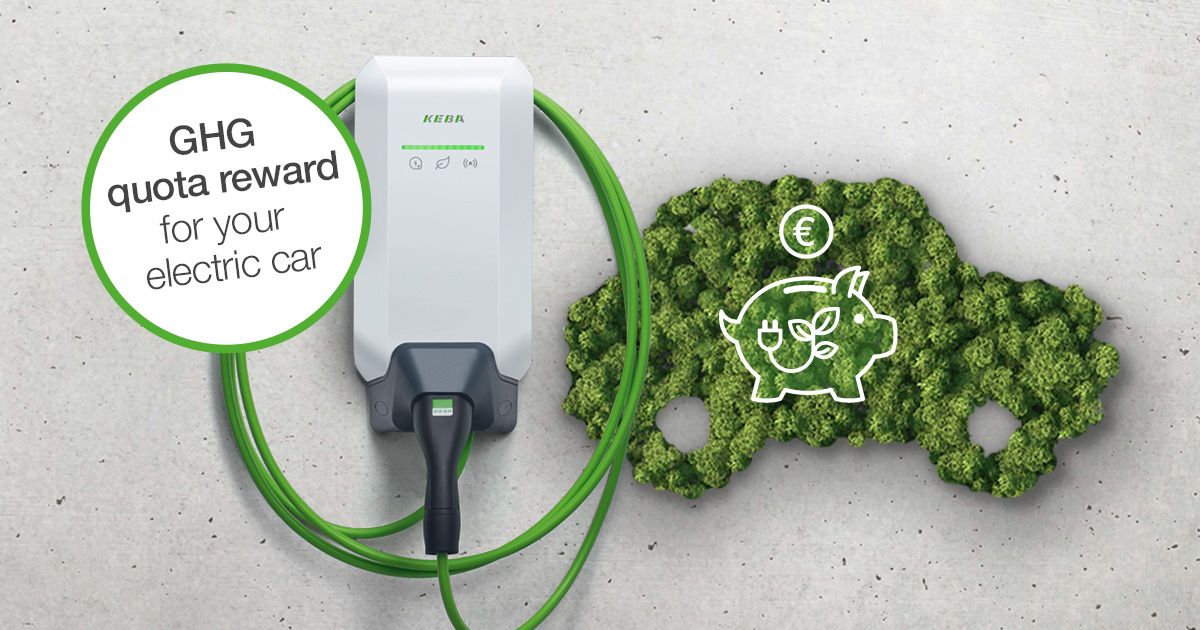
With KEBA and our partner Elektrovorteil, you can receive up to €400 in GHG premium for your vehicle for the 2026 quota year in Germany. The submission deadline is 10 November 2026 at 12 noon. An attractive offer for Austria will follow soon.
What are the GHG quota and ePremium?
Oil companies are required to reduce, year on year, a proportion of the CO₂ emissions resulting from the combustion of their fossil fuels. This is known as a greenhouse gas reduction quota. To meet this GHG quota, the obligated parties (that is, the oil companies) can either increase the bio-based or synthetic share of their fuels or purchase something like offsetting certificates. Through specialised agencies, they indirectly pay registered keepers of electric vehicles and operators of public and semi-public charging stations an annual amount because these parties effectively save transport emissions on their behalf and thus indirectly decarbonise transport. In Germany, this payment is called the GHG premium; in Austria, it is called the ePremium. The amount can be significant: if oil producers fail to meet their quotas, they face high penalties for every additional tonne of CO₂ emitted.
How can I claim the GHG premium or ePremium for a charging station?
How the premium is calculated depends on whether the charging station is publicly accessible or private, and whether it is located in Germany or Austria.
Public and semi-public charging stations (Germany and Austria)
Operators of a public charging station (e.g. in a public car park) or a semi-public one (open to the public at certain times, e.g. at hotels, shops or medical practices) receive the premium for every kilowatt-hour actually charged. The charging station must be:
registered with the Umweltbundesamt and the Bundesnetzagentur in Germany;
registered with the Umweltbundesamt in Austria; and
connected and verified for metering accuracy — more specifically, compliant with the applicable metering and calibration legislation
Specialist intermediary agencies handle registration and payment, making it easy to receive the GHG premium.
Private charging stations
Austria: Electricity charged at your private wallbox is remunerated according to the amount actually measured in kilowatt-hours, provided it is measured and recorded in a verifiable way. This requires a certified meter directly at the charging station, such as a MID-compliant meter or one that complies with German metering and calibration law. Only if the amount charged cannot be recorded in this way does a flat rate of 1,500 kWh per vehicle per year apply instead.
Germany: Private charging stations are not remunerated per kilowatt-hour. The premium is always paid as a flat rate per electric vehicle, based on a statutory estimate that is currently 2,000 kWh per vehicle per year. This applies regardless of where or how much you actually charge. The vehicle registration document is required as proof; a wallbox is not necessary.
How much can you earn from the GHG premium or ePremium for your charging electricity?
The premium amount depends on the current market price of the GHG quota and the provider you choose, and changes regularly. Contact providers directly for the latest figures. The calculation is based on:
Public and semi-public charging stations (Germany and Austria): every kilowatt-hour actually charged.
Private charging stations in Austria: every metered kilowatt-hour. If metering is not possible, a flat rate of 1,500 kWh per vehicle per year applies.
Electric vehicles in Germany: a fixed amount per vehicle per year, based on the current estimated figure of 2,000 kWh.
Unlike one-off grants for installing a charging station, the premium is paid anew each year. For a well-used charging point, it can therefore make an ongoing contribution to financing your charging infrastructure.