




Why Downtime Matters More Than Cable Replacement Costs
- Knowledge
- Charging
- 18.6.2026
- Reading Time: {{readingTime}} min
Contents
Rising Numbers: Cable Theft Is Increasing
The issue is no longer confined to isolated incidents or individual markets. Recent reports from Germany and the UK indicate that cable theft is becoming a growing operational and financial concern for charging network operators across Europe.
The growing importance of the issue is reflected by industry organisations such as CharIN, which has established dedicated working groups focused on cable theft prevention. [1]
A major energy company and charge point operator in Germany reported that more than 900 charging cables were stolen from over 130 locations last year. This striking figure highlights how vulnerable fast-charging infrastructure remains and shows that cable theft is no longer an isolated issue. [2]
Aggregated police reports from across the UK identified more than 200 cases of theft and vandalism targeting EV charging infrastructure since 2022, causing millions of pounds in damage. Researchers and industry experts suggest that the true scale may be significantly higher due to underreporting. [3]
Research conducted on behalf of police forces in England and Wales found that theft and vandalism targeting EV charging infrastructure more than doubled in 2024. [4] Some charging operators have gone as far as deploying private security patrols to protect charging infrastructure from cable theft. [5]
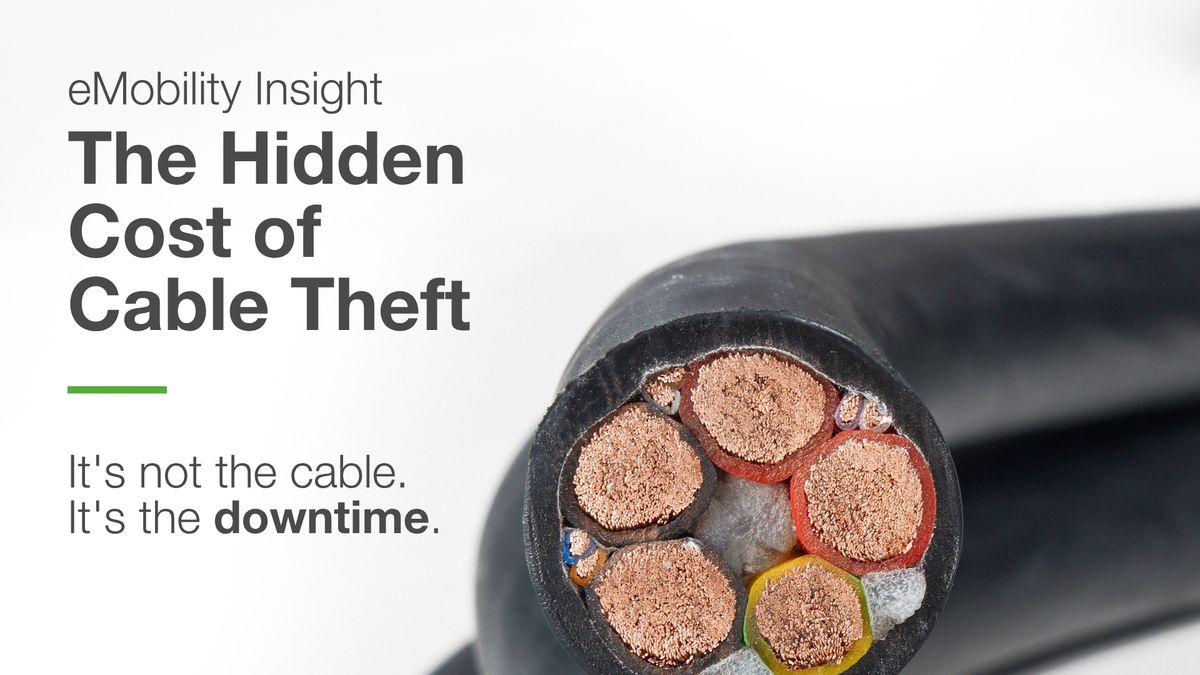
Many Charge Point Operators report significant increases over the past three years. The targeted nature of many incidents suggests that offenders are becoming increasingly specialised, highlighting a more systematic approach to cable theft. One key driver is the rise in raw material prices. Fast-charging sites are particularly attractive targets because high-power charging cables contain several kilograms of copper.
Concerned about the operational impact of cable theft?
Discuss practical approaches to reducing downtime and protecting charging revenue.
Total Damage Far Exceeds Replacement Costs
For CPOs, the replacement cable is often the smallest part of the loss. Depending on length, cable cross-section, and cooling technology, a single charging cable typically costs several thousand euros.
However, the real impact comes from lost revenue and the associated loss of profit. A single fast-charging session for a passenger vehicle can easily generate €50 in revenue. For a truck, revenues can amount to several hundred euros - within just 30 to 45 minutes.
When a charging cable is cut and stolen, the EV charging station is usually out of service for several days or even weeks. Not only must a replacement cable be sourced and installed, but the charging station must also undergo a legally required metrology compliance inspection afterwards. As a result, repair and opportunity costs can quickly exceed €10,000 for a single charging station. If several cables are stolen at once, the resulting losses can easily reach six figures.
On top of this, frustrated customers who either face long waiting times or find only defective EV charging stations associate that negative experience with the CPO’s brand. This damages the CPO's reputation and ultimately impacts future revenues. The result is a lasting form of damage that cannot simply be repaired.
Why Early Detection Matters
For this reason, it is crucial for CPOs to implement measures that prevent cable theft from occurring in the first place. Prevention is far more effective than attempting to minimise costs and response times after a theft has already happened.
As long as the charging infrastructure remains operational, there is no loss of revenue, and customers’ core expectations of a charging site are met.
Several approaches are available:
- The traditional solution is to reinforce the cable sheath. Special steel or Kevlar fabrics make cables more resistant to cutting. This makes theft more difficult and time-consuming. However, disadvantages include higher cable costs and potentially reduced ease of handling due to the integrated armour. Retrofit solutions can also appear visually unappealing and detract from the overall appearance of a charging site.
- Another deterrent approach involves charging cables that release indelible dye when damaged. This helps identify offenders. While it does not technically prevent theft, the system is clearly recognisable and is intended to discourage criminals from attempting it.
- Integrated alarm systems offer another deterrent. If the cable sheath is breached, a loud alarm is triggered to scare off offenders while simultaneously notifying operators and security personnel.
- Active video surveillance can also protect entire charging sites through deterrence and help investigate theft incidents more effectively.
Despite reinforced cable designs, alarms and surveillance systems, operators continue to report theft incidents. One challenge is that many existing measures either require physical damage to occur before an alarm is triggered or depend on retrospective video review after an incident. As a result, operators often receive notification only after service disruption has already begun.

Preventing EV Charging Cable Theft Before Downtime Occurs
This operational gap raises an important question: can potential theft attempts be identified before physical damage occurs?
To explore this challenge, KEBA has developed an early-stage monitoring concept that combines local AI-based analysis with real-time alerting. Rather than hardening the cable itself, the approach focuses on detecting suspicious activity around charging infrastructure before a theft attempt is completed.
Designed for Charge Point Operators (CPOs), charging network operators, fleet charging hubs, and public fast-charging sites, the solution uses local AI-based monitoring to identify patterns of behaviour that may indicate a potential theft attempt, allowing operators to assess the situation and respond at an earlier stage.
How It Works
A local AI system analyses activity around charging infrastructure for behavioural patterns and objects that may indicate a potential theft attempt, such as bolt cutters or angle grinders. Suspicious behaviour and tools commonly associated with cable theft can be detected early, enabling operators to intervene before damage occurs. This direct intervention forms a key part of the deterrence strategy.
In addition, an alarm can be activated, linked to sirens and supplementary lighting, while simultaneously notifying the Charge Point Operator or a security service. When the system detects a potential threat, video documentation can be triggered to support subsequent investigations and potential criminal prosecution. As recordings are event-based rather than continuous, only relevant incidents are documented. Clearly visible warning notices further enhance the deterrent effect before any incident occurs.
Beyond Cable Theft Prevention
While the initial focus is on preventing cable theft and reducing downtime, the underlying monitoring approach may support additional use cases in the future. The same AI-based analysis could potentially help identify other forms of vandalism, detect vehicles blocking charging bays, or support broader site management and operational monitoring.
Privacy by Design
Privacy considerations are built into the system design. AI models are trained to recognise predefined objects and security-relevant acoustic patterns associated with potential threats.
Audio processing focuses on event detection rather than content interpretation. Video recording is triggered only when predefined acoustic or visual indicators suggest a potential security incident. Data is processed locally, minimising data transmission and long-term storage requirements while supporting GDPR-compliant operation.
Conclusion: Using AI to Prevent Cable Theft
Cable theft has become a significant factor in the profitability calculations of Charge Point Operators. To sustainably reduce the impact of charging cable theft, operators should look beyond isolated hardware solutions and consider targeted deterrence through modern monitoring technologies.
AI-supported monitoring approaches such as KEBA's represent a promising addition to existing cable theft prevention measures. By focusing on early detection and rapid response, they aim to help operators reduce downtime and improve charging network availability.
In essence, AI-powered monitoring combines continuous surveillance, intelligent threat detection, and real-time intervention to help identify potential risks before damage occurs. By enabling earlier response, Charge Point Operators can strengthen site security without the ongoing personnel costs associated with on-site security staff.
Already operating an existing charging network?
AI-Supported Prevention of Cable Theft can be easily retrofitted and works across mixed EV charging infrastructure environments, including charging stations from different manufacturers.
Concerned About Downtime Caused by Cable Theft?
Experiencing cable theft or vandalism at your charging sites? Discuss practical prevention strategies and monitoring approaches with the KEBA eMobility team.
Sources
[1] Charging Interface Initiative (CharIN) e. V. (2025): Tackling cable theft at EV charging stations: insights from the CharIN working session (Link)
[2] Tagesschau (2025): Kriminelle stehlen immer mehr Kabel an Ladesäulen (Link)
[3] Electrive.com (2025): Taking stock of cable theft in the UK (Link)
[4] Energy Saving Trust UK (2026): EV charger vandalism (Link)
[5] Auto Express (2024): Recognise EV chargers as critical infrastructure to stop cable thefts, says charging CEO (Link)