



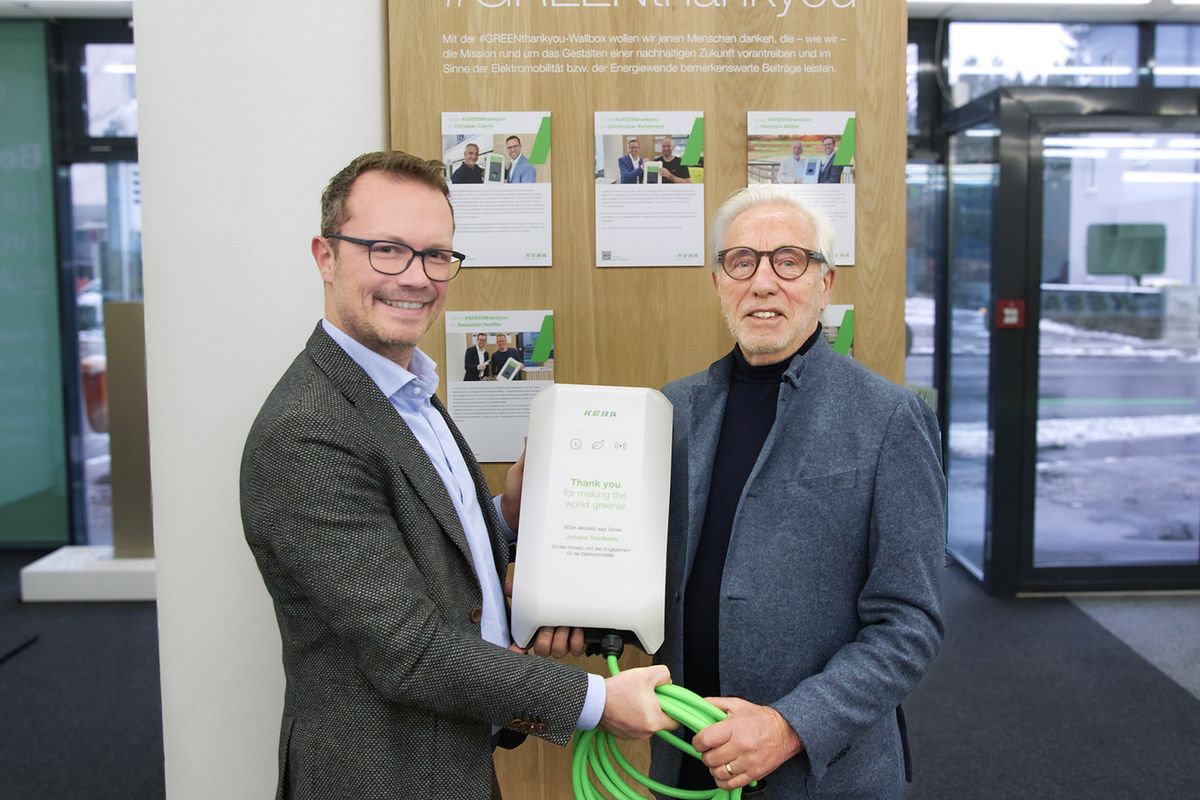
Our #GREENthankyou to Johann Tomforde
- #GREENThankYou
- News
- Corporate
- Environmental Considerations
- 22.1.2026
- Reading Time: {{readingTime}} min
Contents
Commitment deserves a thank you. With our #GREENthankyou Wallbox, we recognise people who are helping to advance e-mobility or shape the energy transition. Their commitment makes a difference – thank you.
Johann Tomforde – a visionary in the midst of the internal combustion era
Johann Tomforde was born in 1946. He therefore spent most of his professional career at the very height of the internal combustion engine era. In terms of ideas, however, Tomforde was always far ahead of his time. He began his career as a motor mechanic and later completed a degree with a focus on automotive engineering and design. Yet as early as his final thesis in 1969, he made it clear that he was a visionary: his solution for the mobility of the future – with the target year set at 1984 – was the “Tomforde Electric City Car”, or TECC for short. Designed for two occupants, the vehicle was intended to make driving and parking in cities significantly easier and to be powered entirely by electricity.

A driving force at Mercedes in Stuttgart
With his degree completed and this strong vision in mind, Tomforde applied to various automotive manufacturers. He ultimately chose Daimler-Benz (now Mercedes-Benz) and in 1970 joined the department responsible for developing future vehicle concepts. His idea of a small, agile yet safe car for short-distance travel immediately convinced his superiors.
“My motto was always: better to be blamed once for doing something right than to ask three times too often.”
Over the years, Tomforde was entrusted with a wide range of projects at the Stuttgart-based company and developed into a respected voice within the organisation as a generalist who looked beyond individual technical tasks. Despite the great success of Mercedes’ internal combustion engines at the time, he continued to pursue his idea of an electric city runabout with unwavering determination. Tomforde proved persistent: he began experimenting with different battery technologies at an early stage and, as a professor at the Pforzheim University of Design, tirelessly encouraged his students to rethink problems from first principles rather than settling for incremental improvements.
One of the creators of the Smart
In the early 1990s, the time was finally right to bring a microcar to life. At Mercedes, Tomforde took charge of the project that would later become the globally renowned Smart – a project for which he had laid the foundations more than 20 years earlier. Even though the two-seater was produced with a petrol engine in its first generation, “it was never intended as an internal combustion vehicle,” Tomforde explains. In the 2000s, electrification finally followed. Today, the brand’s entire product range is fully battery-electric.

For many years now, Tomforde has naturally also driven electric vehicles in his private life. His wallbox is now eight years old and no longer reflects the latest state of the art. The brand-new KeContact P40 wallbox therefore came as a particularly welcome gift – and for us at KEBA, it is a way of saying thank you to a true pioneer of electromobility.